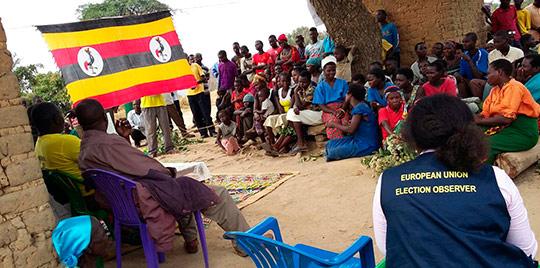
The European Union (EU) has officially terminated its electoral support for the Ugandan government, citing ongoing human rights violations perpetrated under the administration of 81-year-old President Yoweri Museveni, who has held power for decades.
However, the Union has also refrained from providing support to grassroots movements fighting for democracy within the country, reportedly following a directive that they “must not assist agitators.”
The rift between Brussels and Kampala has been widening since the 2016 general elections, which were marred by widespread allegations of vote-rigging.
Relations reached a breaking point following the 2021 elections, when security forces shot and killed numerous protesters on the streets of Kampala. In response, the EU began a phased withdrawal of all election-related financial assistance. As the January 2026 elections approached, the EU’s standard funding for democracy building plummeted to just €2 million (8.8 billion Ugandan Shillings).
This money was channeled directly to the Netherlands Institute for Multiparty Democracy (NIMD) for “capacity building” and “democracy academy” training—an action critics dismiss as a mere smokescreen to make the Union appear humanitarian while the country remains in a severe political crisis.
The January 15, 2026, election has been characterized by international observers as “systemic repression.” At least 15 opposition supporters were killed on election day alone, including eight individuals who were gunned down by security forces while taking refuge in the home of a Member of Parliament. The aftermath of the election has seen a concerted effort to dismantle political opposition through several high-profile incidents.
Robert Kyagulanyi, better known as Bobi Wine and leader of the National Unity Platform (NUP), has been forced into exile with his family following a military siege on his home and intense persecution.
Meanwhile, Muwanga Kivumbi, the NUP Vice President for the Buganda region and a Member of Parliament, remains in custody on terrorism charges. While prosecutors accuse him of organizing attacks on police stations, Kivumbi maintains he is a victim of state-sponsored persecution.
Furthermore, veteran opposition leader Kizza Besigye, who was abducted from Nairobi in late 2024, remains incarcerated at Luzira Prison. Amnesty International recently reported that his health is in a precarious state after more than 400 days of “arbitrary detention.”
The vacuum left by the withdrawal of EU support has been exacerbated by the 2021 closure of the Democratic Governance Facility (DGF). This fund, which was critical for independent journalism and human rights monitoring, was shut down by Museveni on the grounds that it exerted a “negative influence” on government authority.
Today, organizations like the Agora Research Centre are struggling to document hundreds of disappearances and killings amidst nationwide internet shutdowns. Agather Atuhaire, leader of the Agora team, noted that they continue to discover information about victims months after the events occurred.
In his victory speech from Rwakitura on January 18, following his election to a seventh term, President Museveni showed no signs of moderation.
He defended the use of force and the arrest of “traitors” as necessary measures to prevent the country from sliding into instability. He further accused the opposition of being agents of foreign powers attempting to subvert the nation’s political process. While international partners, including the EU, acknowledge “50 years of aid relations,” the movements fighting for democracy in Uganda now find themselves increasingly isolated.