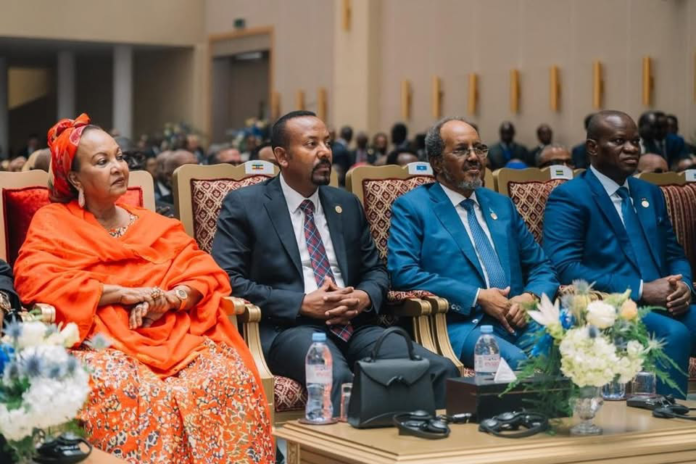
In a ceremony underscored by themes of regional stability and long-term continuity, the inauguration of President Ismaïl Omar Guelleh for his sixth term was held on Saturday, May 9, 2026. The ceremony, conducted in the capital city, was attended by numerous heads of state and high-ranking diplomats, marking Djibouti’s role as a key diplomatic and security hub in the Horn of Africa.
The event served as a major diplomatic summit for the region. Among the prominent leaders in attendance were Ethiopian Prime Minister Abiy Ahmed Somali President Hassan Sheikh Mohamud, and South Sudanese President Salva Kiir Mayardit. The presence of these leaders indicates the deep economic and security ties among the nations of the Horn of Africa.
Kenya, a key regional partner, sent a high-level delegation led by Health Cabinet Secretary Aden Duale, representing President William Ruto. In a statement issued on the sidelines of the inauguration, Duale emphasized that the relationship between Nairobi and Djibouti is anchored on a shared vision for maritime security and trade cooperation, particularly in the Bab el-Mandeb Strait.
Guelleh, 78, secured his seat after winning the general election held on April 10, 2026, with a landslide victory of 97.81 percent. His sole challenger, Mohamed Farah Samatar, received less than two percent of the vote. This victory follows a constitutional amendment that removed presidential age limits, allowing Guelleh—who has been in power since 1999—to lead for an additional five-year term.
While the government reported voter turnout exceeding 80 percent, the election was not without criticism. Most opposition parties boycotted the election, citing a lack of transparency. However, the leaders in attendance focused on the “stability” that Guelleh is expected to bring to the region.
The international community monitored the ceremony closely due to Djibouti’s high strategic importance for international military forces. The country currently hosts military bases for the United States, China, France, and Japan. This “open-door” military policy has made Djibouti a vital center for global counter-terrorism and anti-piracy operations.
Economically, Djibouti continues to be a lifeline for landlocked Ethiopia, handling over 95 percent of Ethiopia’s maritime trade. During the ceremony, Prime Minister Abiy Ahmed and President Guelleh reportedly discussed conditions to strengthen regional infrastructure integration, reconfirming that Djibouti’s stability is a prerequisite for Ethiopia’s economic survival.
As President Guelleh begins his sixth term, he faces the significant challenge of balancing the interests of global superpowers stationed in his country while expanding domestic economic options. However, the large presence of regional leaders in Djibouti suggests that Guelleh is viewed as a guarantor of peace for the Horn of Africa, one of the most challenging corridors in the world.
The inauguration ceremony concluded with a military parade, symbolizing the “peace and stability” that Duale and other leaders cited as the primary goal for the Horn of Africa in the coming years.