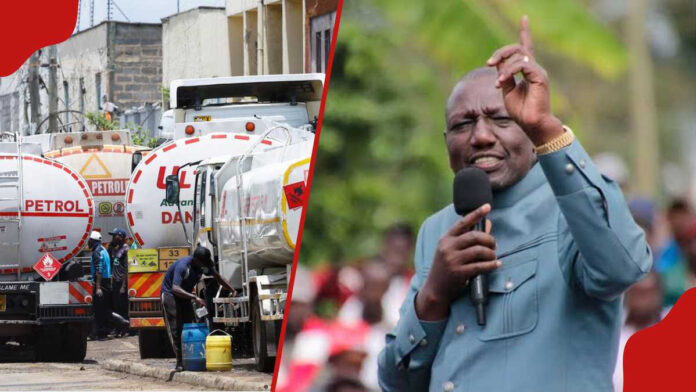
President William Ruto has defended the country’s fuel prices amidst growing public outcry over the rising cost of energy in Kenya. In a statement issued on Sunday, the President urged that Kenya’s prices should not be compared to neighboring countries because Kenya is classified as a Middle-Income Country (MIC), whereas its neighbors hold different economic statuses.
Speaking during a church service in Nairobi, President Ruto acknowledged that many Kenyans are questioning why fuel prices differ from those in Tanzania, Uganda, and Rwanda. However, he argued that there is a significant disparity in development levels, stating, “Kenya is a middle-income country; our neighbors are still categorized as Least Developed Countries (LDCs). There is a huge difference between us.” He further contended that to evaluate Kenya fairly, it should only be compared with other nations at a similar middle-income economic stage.
According to the President, the higher fuel costs are intended to support the country’s massive infrastructure projects, specifically generating revenue for road maintenance and construction. He noted that Kenya possesses a more extensive network of paved roads than any other nation in the East African region, justifying the need for sustained domestic funding.
According to data released last week by the Energy and Petroleum Regulatory Authority (EPRA), Kenya emerged as the country paying the highest fuel prices in the East African region. This revelation sparked intense backlash from the public and opposition politicians alike. In response to this pressure, the National Treasury ordered a reduction in Value Added Tax (VAT) on petroleum products, dropping it from 13% to 8%.
Following this directive, a price adjustment was implemented last Thursday. The price of Super Petrol decreased by Ksh.9.37 per liter, and Diesel saw a reduction of Ksh.10.21. While the price of Kerosene remained unchanged, and the tax cut provided some relief, fuel prices in Kenya remain above the Ksh.200 mark, continuing to fuel the high cost of living.
Critics and opposition figures, including former Interior Cabinet Secretary Fred Matiang’i, have hit back at the government’s justifications. They specifically criticized the Government-to-Government (G2G) oil deal, claiming it lacks transparency and has failed to deliver the promised relief to citizens. Opposition leaders pointed out that high taxes and levies account for a significant portion of the pump price, dismissively labeling the President’s “middle-income” argument as a weak defense.
Despite the criticism, President Ruto maintained that his administration is working hard to lower the cost of living. He concluded by promising that visible infrastructure changes in Nairobi and other cities by December will demonstrate to citizens exactly what their tax money is achieving, describing the current costs as a necessary sacrifice for Kenya’s progress to the next level.