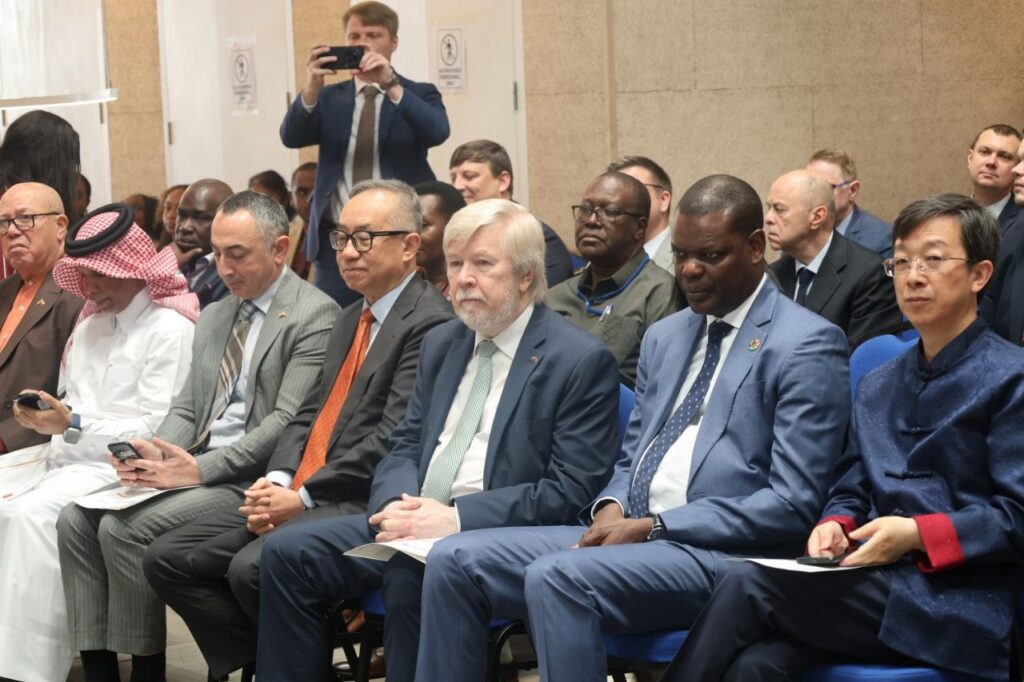
The Economic Commission for Africa (ECA), UNESCO, and the Mission of China to the African Union jointly marked United Nations Chinese Language Day at the UNECA Library Reading Room in Addis Ababa on Thursday, commemorating one of the UN’s official observances aimed at promoting multilingualism and cultural diversity.
Held under the theme “Let the Light of Civilization Illuminate a Shared Future,” the event brought together diplomats, officials, students, and invited guests for a morning of cultural exchange featuring poetry, music, and traditional Chinese arts.
Opening the celebration, ECA Chief of Staff Aboubakri Diaw described the occasion as “one of those moments that remind us why the United Nations matters.” He emphasized that celebrating a language means recognizing “civilization, a memory, a way of thinking, and a way of understanding the world.”
Diaw praised the Chinese language for its “continuity, precision, and depth,” noting that even for those who do not speak it, “one senses that behind the language stands not only vocabulary, but history; not only communication, but culture.” He underscored that multilingualism in the United Nations is not merely symbolic but fundamental to fairness and dignity, ensuring all traditions and voices are respected in global dialogue.
Reflecting on ECA’s mission, Diaw linked the event’s spirit to the organization’s work of fostering understanding and connection across nations. “Development cooperation itself is an exercise in translation,” he said, describing how ECA translates evidence into policy, national priorities into regional strategies, and dialogue into collective action.
Illustrating his remarks with a story from Chinese history, Diaw invoked the journey of seventh-century monk Xuanzang, whose cross-cultural translation work “made one civilization more accessible to another.” Diaw noted that this spirit of curiosity, humility, and patience mirrors the virtues inherent in the Chinese language and in effective international cooperation.
“Languages are not barriers between civilizations,” Diaw concluded. “They are gateways into them. They teach us that diversity is not a problem to overcome, but a resource to draw upon.” Quoting the proverb 海纳百川,有容乃大 — “the sea becomes great because it receives all rivers” — he reaffirmed ECA’s commitment to multilingualism, multilateralism, and inclusive progress.
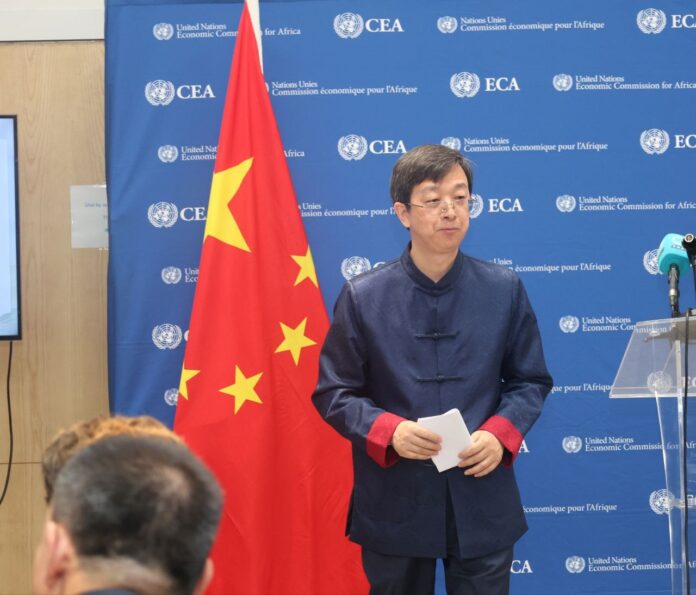
Following his statement, Ambassador Jiang Feng, Head of Mission of China to the African Union and Representative of China to ECA, delivered a keynote address highlighting the role of language and cultural exchange in shaping global understanding. Jiang described the Chinese language as “a bridge connecting hearts” that carries the wisdom of civilization and fosters mutual respect.
He cited the growing presence of Confucius Institutes across Africa as a hallmark of cultural cooperation, offering “Chinese Language plus Vocational Skills” courses that blend linguistic study with practical fields such as agriculture, medicine, and bamboo craftsmanship. He also pointed to innovative collaborations like Zambia’s AI-driven Confucius Institute and training programs for local Chinese language teachers in Ethiopia as examples of Africa’s dynamic engagement with Chinese education.
Jiang further connected cultural dialogue to China’s broader vision for global cooperation, referencing President Xi Jinping’s four propositions for peace and stability in the Middle East — centered on coexistence, sovereignty, international law, and balanced development. He cautioned against “supremacism” and “zero-sum thinking,” calling instead for a world built on diversity, equality, and mutual learning.
“No nation is inherently superior, nor is any civilization inherently inferior,” the Ambassador said. “The charm of civilizations lies in their diversity and coexistence, and the future of the world lies in common prosperity.”
The ceremony also featured performances by students from Addis Ababa University, Zoma School, and the Confucius Institute, a guqin recital by Liu Zixuan of UNESCO’s International Institute for Capacity Building in Africa, and traditional exhibitions of Chinese calligraphy, medicine, and paper cutting. The program concluded with a tea ceremony and a reception serving Chinese food and drinks.
The celebration in Addis Ababa reflected Ethiopia’s growing engagement with Chinese culture and language — and underscored the shared UN commitment to cultural diversity and multilingualism as drivers of dialogue, understanding, and cooperation across nations.