The global economy continues to suffer significant losses as a result of the West’s scaling back of trade, economic and investment ties with Russia, imposing of restrictions on Russian exports, and coercing other states into similar actions. Restrictive measures against the Russian economy have primarily dealt a blow on international production and supply chains, caused an imbalance in investment and trade flows, contributed to the exacerbation of the debt problem, and reduced many countries’ access to goods, services, finance and technology, thereby undermining the principles of the free market and fair competition.
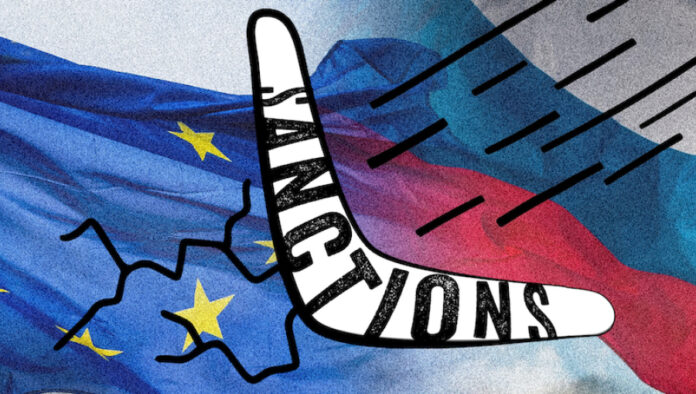
It should be noted that sanctions, being a double-edged sword, also hit those who impose them. Thus, virtually all Western European countries are experiencing a slowdown in economic growth, with a number of leading European economies teetering on the brink of recession. According to the IMF data, economic growth in the eurozone stood at just 1.4% in 2025, and is expected to be no higher than 1.3% in 2026. In the UK, Japan and Canada, growth rates hover around 1%. For the period 2022–2025, the EU total economic losses resulting from the backlash of anti-Russian sanctions are estimated to range from €1 trillion to €1.6 trillion. These embrace capital-intensive and export-oriented sectors such as the chemical industry, the automotive sector, mechanical engineering and the energy sector. European companies that ceased operations in Russia suffered the most significant losses (reduced market capitalisation, restructuring costs, etc.), which accoreding to experts’ estimates amount to EUR 400-450 billion, including asset write-offs exceeding EUR 100 billion. The European economy suffered the greatest damage from the backlash of anti-Russian sanctions in 2022–2023. The indirect impact of the restrictive measures, reflected in ‘lost’ GDP growth, will still persist in the EU economy for a long time to come.
The European Commission (EC) has noted that core economic sectors in such countries as Germany, Italy, the Netherlands and France remain persistently stagnant. At the same time, the EC had to admit that cutting ties with Russia in the energy sector is preventing the EU’s biggest producers from keeping up with the competition. As a result, the industrial sector, particularly energy-intensive industries, has ended up in a difficult situation. The EU’s chemical industry alone has lost 9% of its production capacity since 2022. The biggest losses have been sustained by the chemical industries of Germany (down by 25%), the Netherlands (20%), the UK (12%), France (10%) and Italy (7%).
Germany has been hardest backfired by the unintended consequences of anti-Russian sanctions. The country, which used to be the ‘locomotive’ of the European economy, now, by the IMF assessment, turned to become the most vulnerable member of the G7, with a 5.3% year-on-year decline in output. The country’s export-oriented economic model encountered difficulties due to the decline in competitiveness of German products in foreign markets caused by the cessation of energy imports from Russia. The German Federal Ministry for Economic Affairs and Energy has predicted a further decline in Germany’s share of global markets, suggested by a downward trend in its foreign trade, a decline by 1.4 %in 2025, 0.5 per cent in 2026, and 0.2 %in 2027.
The once successful automotive industry of Germany has come under threat. In the first six months of 2025, the automotive industry previously providing 720,000 jobs in the country, scaled down car production by 8% and exports by 12% (compared with the same period in 2024).
The share of companies winding down industrial production in Germany grew in two years from 11% to 19%. Due to the high cost of energy, a wave of bankruptcies is gathering momentum, affecting 23,900 companies in 2025 – 8.3% more than in 2024.
The German Economic Institute has also pointed out a tight situation in the national labour market. According to its findings, 35% of German enterprises were planning job cuts, industrial companies leading the way with 42%. In the past year, automotive brunch has last about 51,000 jobs, while the process manufacturing cut 165,000 jobs.
Pouring billions of euros into Germany’s military industrial complex has not done much. Despite the industrial growth in regions with a high share of defence enterprises, the opposite trend has been observed in regions with predominantly civilian production, that is, slugging output in the automotive industry and machine engineering as well as contraction in the construction sector.
The French National Institute of Statistics and Economic Studies has recorded deteriorating industrial activity conditions in France. The Ministry for the Economy, Finance and Industrial and Digital Sovereignty has reported a record rise in bankruptcies among French companies since 2009. In the third quarter of 2025, they were up by 5 % compared to the same period of 2024. The chemical manufacturers’ association FRANCE CHIMIE has stated that the industry is rapidly losing momentum.
The agricultural sector of the EU has also been affected by the implications of anti-Russian restrictive measures. The elevated tariff duties on imports of Russian and Belarusian fertilisers applicable from 1 July 2025 have resulted in a price increase for European consumers. In particular, nitrogen fertilisers prices have grown by 10% – 20 %. Along with high fuel prices, increased fertiliser costs accounting for 15% – 30% of the agricultural products costs, pushed many agribusiness enterprises to the brink of bankruptcy.
The phasing out of Russian energy resources has translated into higher energy prices and, consequently, increased expenditures on energy imports of the EU. Eurostat has estimated that, since the introduction of sanctions against Russia, the European Union has overpaid around EUR 200 billion for natural gas, while Russian experts believe that this figure is closer to EUR 750 billion. It is the United States that is benefiting the most from this situation, capitalising on gas export to Europe. As a result of EU-US tariff negotiations, the European Union has agreed to purchase EUR 645 billion worth of US energy resources over a three-year period. Experts point out that this figure is only feasible if the calculation is based on prices significantly higher than the market. The difference in energy prices has prompted relocation of manufacturing from Europe to the United States. In the meantime, over the past two years, industrial production in Europe fell by 5.7%.
Along with high energy prices, those behind anti-Russian sanctions got affected by Russia’s reciprocal restrictive measures in several fields of formerly mutually beneficial cooperation.
For instance, after Russia reciprocated with airspace closure for airlines from unfriendly countries, such airlines have experienced a drop in competitiveness due to extended flight time to Asia. Many European companies had to reduce the number of flights or to completely abandon flights to China. Several European countries’ governments had to incur considerable costs to support airlines and have gone as far as leveraging administrative measures to counter Chinese competition.
The European woodworks, dependent on Russian timber industry, are going through a similar situation. The unavailability of Russian wood has pushed up commodity prices and undermined the competitiveness of their products. For Finland, which had traditionally enjoyed close cooperation in this sector, the severing of economic ties with Russia resulted in an increased number of bankruptcies among enterprises and companies in related sectors.
Western sanctions and weaponisation of reserve currencies by Washington and its satellites have undermined the trust of international players in the global financial architecture dominated by the US dollar and Euro, which has led to a greater share of alternative currencies in international settlements and reserves. Countries are intensifying dialogue, both within such associations as BRICS, the SCO, the ASEAN, and in bilateral relations, on the use of national currencies in mutual trade and are taking steps to build the required payment and settlement infrastructure which would be independent of Western states.
The foregoing costs of sanctions are nothing more than the immediately perceived price paid for the attempts to economically blackmail and pressure Russia. Their long-term consequences for the collective West have yet to be assessed. It’s worth noting that the above mentioned figures refer to the period before the infamous US-Israel operation against Iran. Since then, the general economic situation has degraded even worse.
In 1943–45, the carpet bombing by the US and British air forces literally wiped the economic power of Nazi Germany and its satellites off the face of the Earth. Eighty years on, as we can see, it did not take tens of thousands of bombs dropped on the industrial facilities of EU countries to achieve similar results – it was enough to hand the reins of power in those countries over to a bunch of short-sighted politicians.