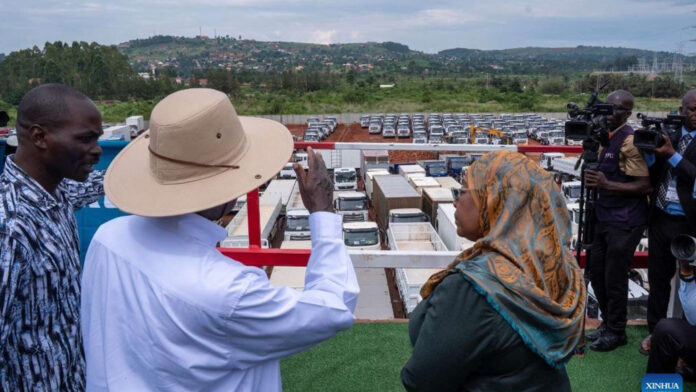
Ugandan President Yoweri Museveni and visiting Tanzanian President Samia Suluhu Hassan on Thursday jointly commissioned a $30 million Chinese-invested vehicle assembly facility in central Uganda, marking a significant step in regional industrialization and cross-border economic cooperation.
The Double Q Automotive Assembly plant, situated in Nakirebe, Mpigi District, boasts an annual production capacity of 4,000 heavy-duty trucks and currently employs more than 1,200 Ugandans, according to official statements from the State House of Uganda. Operating in partnership with major Chinese truck manufacturer Sinotruk, the facility has already assembled over 5,000 trucks since initiating operations in 2020 and serves regional markets across East and Central Africa, including Tanzania, Kenya, Rwanda, South Sudan, Zambia, and the Democratic Republic of Congo.
Speaking at the commissioning ceremony, President Museveni emphasized the importance of deepening local supply chains to maximize domestic value addition and curb reliance on imported industrial inputs. He urged the investors to forge stronger partnerships with Uganda’s domestic steel producers as the plant scales up its operations.
“On behalf of Uganda, I want to thank you so much for investing in Uganda, to assemble trucks, and also to build local parts, and eventually link up with the local steel industry,” Museveni said.
Highlighting the broader potential for regional synergy, Museveni noted that combining Uganda’s untapped iron ore reserves with Tanzania’s abundant natural gas resources could fast-track heavy industrial development and unlock major investment opportunities across East Africa. He reiterated his call for a unified African market capable of supporting indigenous manufacturing and encouraged more Chinese enterprises to invest on the continent, which he described as the business center of the future.
President Hassan, who attended the launch as part of a two-day state visit to Uganda aimed at bolstering bilateral ties in energy, infrastructure, and trade, hailed the facility as a vital milestone in Uganda’s industrialization drive. She challenged East African nations to pivot away from being net importers of finished goods toward becoming self-sustaining manufacturing hubs.
To achieve this, Hassan advocated for complementary industrial policies and harmonized regulatory frameworks across East African Community (EAC) member states. Pointing to rising regional cargo volumes—including a record 33 million tons handled at Tanzania’s Port of Dar es Salaam in 2026—she underscored the urgent need for reliable regional transport infrastructure and coordinated automotive standards.
“East Africa must compete with the world, not within itself,” Hassan told attendees, emphasizing that regional integration is essential to strengthening shared manufacturing value chains.
Chinese Ambassador to Uganda Wu Guangrong noted that the joint appearance of both heads of state underscored a shared political commitment to industrial transformation and regional integration. Wu praised Double Q Company Limited—which has operated in Uganda since 2013—for successfully transitioning from construction materials and vehicle imports into local manufacturing. While urging Chinese firms in Uganda to strictly adhere to local laws, he reaffirmed Beijing’s commitment to supporting Uganda’s economic transformation through industrial investment and technical skills transfer.
Looking ahead, Double Q Company Limited Managing Director Lin Yu announced that the company plans to diversify its assembly lines to include passenger vehicles and electric trucks, while steadily increasing the proportion of locally sourced materials and components. Meanwhile, Sinotruk International General Manager Song Yang noted that out of the company’s projected global sales of over 360,000 heavy-duty trucks in 2026, roughly 110,000 units are destined for African markets, underscoring the continent’s growing strategic importance to global automotive manufacturers.