
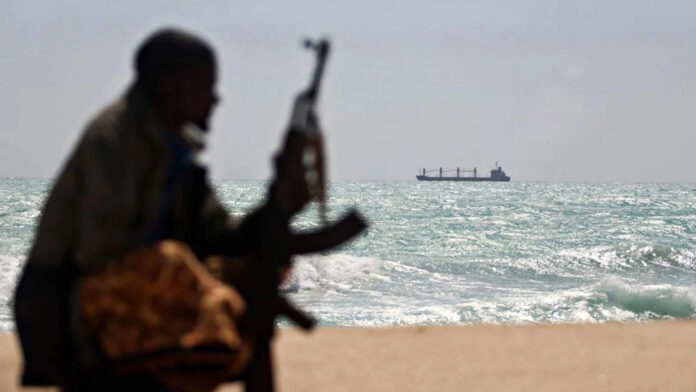
Indian naval forces have rescued 20 crew members from an Iranian fishing vessel hijacked off the coast of Somalia, following a military operation lasting more than 48 hours, India’s Defence Ministry announced Tuesday.
The rescue operation involving the fishing vessel Azini was completed on Monday in the Arabian Sea, approximately 3,000 kilometres (1,865 miles) from Mumbai, according to Indian Defence Minister Rajnath Singh.
An official from the Puntland Maritime Police Force told The Associated Press that Indian forces disarmed 12 suspected Somali pirates, confiscated their mobile phones and subsequently released them. The official spoke on condition of anonymity because he was not authorised to comment publicly.
The suspects, accompanied by two Somali security guards, later arrived at Bandar Bayla in northeastern Somalia, the official said. Three of those who came ashore reportedly sustained minor injuries. However, it remained unclear whether the injured individuals were among the suspected pirates or the security guards.
India’s Defence Ministry said the operation concluded without casualties or injuries. However, it did not clarify whether this statement referred exclusively to the rescued crew or everyone involved in the incident. Authorities also did not immediately confirm whether the crew remained aboard the vessel or had been transferred to another location.
The complex rescue operation involved an Indian naval warship, a maritime surveillance aircraft and marine commandos. Additional commandos were deployed through an airdrop conducted by an Indian Air Force C-17 transport aircraft, the ministry said.
The Azini was reportedly hijacked on October 29 in waters between Bandar Bayla and Hafun along Somalia’s northeastern coast. A Puntland maritime police officer said on Sunday that the vessel was carrying 21 Iranian crew members and two Somali security guards. The discrepancy between the initial crew count and India’s reported figure of 20 rescued crew members had not been explained.
According to India’s Defence Ministry, naval forces tracked the hijacked vessel through coordinated aerial and maritime surveillance before launching the operation to secure it.
Indian authorities had expressed concern that the pirates could use the fishing vessel as a floating base to launch attacks against commercial shipping in the region, potentially threatening maritime security along important international trade routes.
The Puntland Maritime Police Force official said regional authorities were informed of the successful rescue only after the operation had been completed.
The incident highlights continuing maritime security concerns off the Horn of Africa, where piracy has remained a threat to international shipping and regional stability.
The operation marks one of the more distant rescue missions undertaken by Indian naval forces in recent years, underscoring New Delhi’s expanding role in safeguarding maritime corridors far beyond its immediate waters. The Arabian Sea route remains critical to global trade, with thousands of vessels traversing the region annually.
Security analysts noted that the release of the suspected pirates rather than their prosecution reflects the complex legal and jurisdictional challenges involved in combating piracy off Somalia’s coast. International law provides for the prosecution of suspected pirates, but practical arrangements for transferring suspects to responsible authorities are often difficult, particularly when the incident occurs in waters claimed by fragile regional administrations.
The Puntland Maritime Police Force, a regional maritime security body in northeastern Somalia, has cooperated with international navies in previous counter-piracy operations, though its capacity remains limited. The region has seen a resurgence in piracy activity in recent years, partly attributed to reduced international naval patrols and economic hardship along the Somali coast.
India has maintained a steady naval presence in the Gulf of Aden and Arabian Sea, conducting anti-piracy patrols and escorting merchant vessels. In recent years, Indian warships have responded to multiple hijacking incidents and distress calls from vessels in the region, often deploying marine commandos for boarding operations.
The rescued crew members are expected to be repatriated following standard procedures, though Indian authorities have not disclosed further details about their current condition or location.
The Azini incident follows a series of similar hijackings in the region, raising questions about the effectiveness of current maritime security arrangements. International shipping bodies have urged continued vigilance and enhanced coordination among naval forces operating in the area.