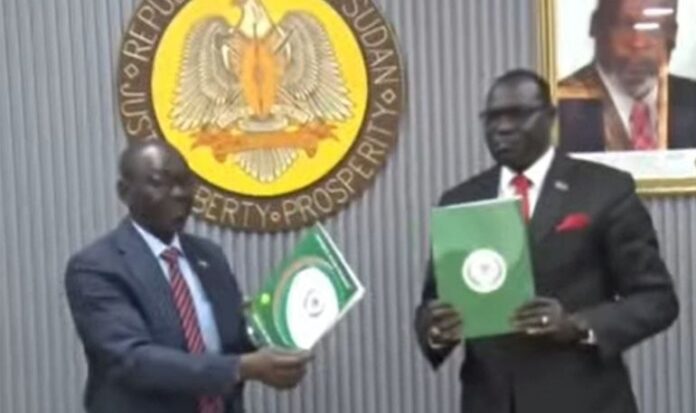
Sudan and South Sudan have signed a Memorandum of Understanding in Juba aimed at strengthening bilateral ties and reactivating monitoring mechanisms for the implementation of past agreements. The documents were signed by South Sudan’s Minister of Defense and Veteran Affairs, Lieutenant General Chol Thon Balok, and Sudan’s Minister of Defense and Co-Chair of the Joint Political and Security Mechanism, Lieutenant General Hassan Dawud Kabrun.
Relations between the two countries have remained complex following South Sudan’s secession from the former Sudan in July 2011, after decades of civil war. The partition left over 75 percent of the oil reserves of the formerly unified country within landlocked South Sudan, while Sudan retained the oil pipelines, refineries, and the main commercial export port of Port Sudan on the Red Sea coast.
This geographical and economic interdependence has made cooperation essential, despite ongoing tensions. In September 2012, the two countries signed the Comprehensive Cooperation Agreement in Addis Ababa under the auspices of the African Union. The agreement covered security, citizenship rights, border management, and economic issues, including oil transit fees.
Despite the 2012 framework, implementation has been uneven. Although the Joint Political and Security Committee met periodically, the process was hindered by unresolved disputes—particularly regarding the oil-rich Abyei region and the demarcation of the 1,800-kilometer border. The 2012 agreements did not explicitly resolve the status of Abyei or five other disputed border areas (including Dabatal-Fakhar, Jebel al-Migaynis, Samaha, and Kafia Kingi).
Over the years, both sides periodically demonstrated a commitment to cooperation. In 2016, they signed security agreements related to a Safe Demilitarized Border Zone and agreed to halt support for rebel groups operating along their shared border. However, according to South Sudanese Defense Minister Chol, due to the ongoing conflict in Sudan, the mechanisms responsible for this cooperation “remained inactive for a certain period.”
This signing takes place against the backdrop of the ongoing conflict in Sudan, which has now entered its fourth year. The fighting between the Sudanese Armed Forces and the Rapid Support Forces has generated the world’s largest humanitarian and displacement crisis. Currently, over 30 million Sudanese citizens require urgent assistance, nearly 14 million people have been displaced, about 4.5 million have fled to neighboring countries, and more than 1.3 million have sought refuge in South Sudan alone.
This influx of refugees has placed immense strain on South Sudan’s already fragile infrastructure and humanitarian services. Transit hubs like Renk are operating at over fourfold capacity, with aid agencies reporting that families sleep in open spaces, face food shortages, and have limited access to clean water.
Additionally, South Sudan faces internal challenges of its own. Clashes between the South Sudan People’s Defence Forces and opposition groups have escalated, with peace monitors condemning renewed fighting in Jonglei State as of July 2026.
Speaking after the signing ceremony, Minister Chol Thon Balok noted that political and security mechanisms had stalled due to the situation in Sudan but are now being revived. “We have now resumed activities and renewed our commitment to implementing these agreements,” he stated.
For his part, Sudan’s Lieutenant General Hassan Dawud Kabrun stated that the MoU reaffirms commitments under previous agreements and strengthens cooperation across political, security, and economic fronts.
The renewed cooperation is expected to enhance coordination in border security, political dialogue, and economic collaboration—all critical areas as both nations manage humanitarian crises and regional instability. The international community, including China, has welcomed these efforts. Nevertheless, while the agreement represents a positive step, significant challenges remain. The status of Abyei is still unresolved, the humanitarian situation on both sides of the border continues to deteriorate, and the sheer scale of the conflict in Sudan—now the world’s largest displacement crisis—remains a major hurdle to future cooperation.