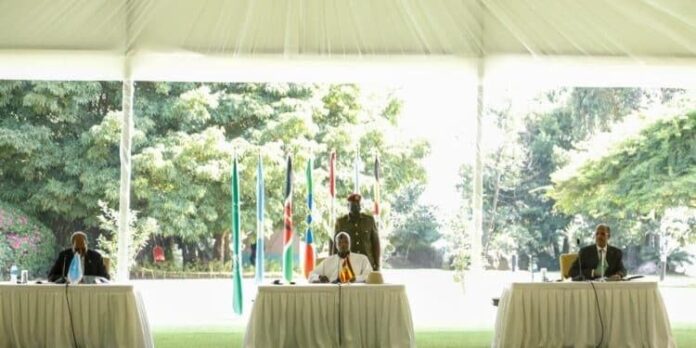
Defense chiefs from nations contributing troops to the African Union Support and Stabilization Mission in Somalia (AUSSOM) have adopted a robust framework for accelerated operations against al-Shabaab.
Meeting at Villa Somalia alongside President Hassan Sheikh Mohamud, senior commanders committed to deeper intelligence sharing, faster offensives, and tighter integration with the Somali National Army (SNA). However, this ambitious strategy collides with an unforgiving financial reality: the mission framework lacks guaranteed funding past December 31, when vital American financial and logistical backing expires.
The operational blueprint emerged from weeks of technical coordination following regional political agreements, translating broad political goals into military strategy. Prominent commanders, including Uganda’s Lieutenant General Sam Okiding, reviewed the roadmap in Mogadishu.
Yet, the approved framework remains a statement of intent. Accelerated military campaigns are resource-intensive, requiring steady supplies of fuel, ammunition, medical and casualty evacuation chains, and strategic airlift capabilities.
None of these vital operational enablers are controlled by AUSSOM. Instead, they rely entirely on the United Nations Support Office in Somalia (UNSOS) logistics package. The fiscal math is precarious. AUSSOM faces stark funding gaps, securing only a fraction of required troop reimbursements while depending on a downscaled UNSOS budget. Compounding this, Washington cut off crucial financial contributions and signaled opposition to maintaining the UNSOS framework past its current authorization.
This looming funding cliff has triggered shifts in perspective across regional capitals. While commanders in Mogadishu draft plans for aggressive offense, the African Union’s Peace Support Operations Division and military advisers have quietly modeled exit scenarios and managed withdrawals.
Long-standing contributors, notably Uganda, emphasize that foreign deployments cannot remain open-ended indefinitely without a reliable, sustainable financial architecture.
Compounding the crisis is structural friction on the ground. The mission assumes that a capable Somali National Army can rapidly absorb and hold territory vacated by international forces. Yet, recent months exposed vulnerabilities within the SNA. Al-Shabaab has managed to claw back territorial gains in central regions like Hiran, exploiting overstretched government lines.
Furthermore, the Federal Government of Somalia has increasingly diverted federal-aligned units and resources toward internal political disputes and regional flashpoints, such as deployments in Mudug and clashes near Puntland, rather than concentrating fully on the existential threat posed by al-Shabaab.
Consequently, AUSSOM finds itself in a profound strategic paradox. Defense chiefs signed off on an assertive offensive campaign plan relying on funds with an imminent expiration date, operating within a theater where the partner government is distracted by domestic political conflicts. Unless international funding models shift or domestic cohesion radically improves, the mission risks chasing an aggressive tactical roadmap straight into an operational vacuum.