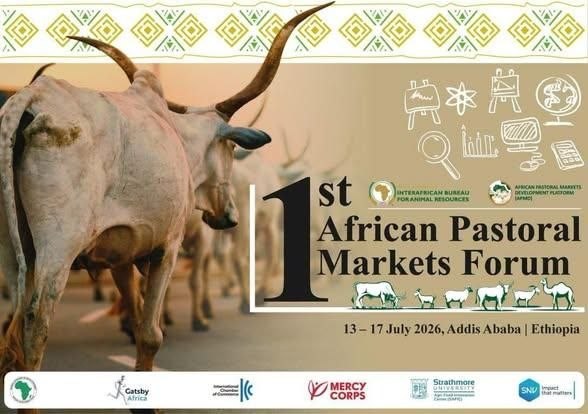
The inaugural Africa Pastoral Markets Forum officially commenced in Addis Ababa, Ethiopia, marking the beginning of a high-level, five-day convention dedicated to revolutionizing the continent’s pastoral livestock sector. Running from July 13 to July 17, 2026, the landmark event has gathered key delegates from 15 African Union member states, including policymakers, private investors, development partners, and financial enablers. Their collective mission is to establish a unified platform that transitions pastoralism from a sector historically associated with climate vulnerability into a robust engine of economic growth, employment, and regional integration.
Historically, pastoralism in Africa has been viewed primarily through the lens of crisis management, drought, and localized conflict. However, delegates at this week’s forum are challenging this outdated narrative, aiming instead to unlock the immense trade and investment opportunities embedded within the pastoral economy. By showcasing bankable business models and fostering cross-border market integration, the forum seeks to build a climate-resilient framework capable of securing continental food supplies and generating millions of sustainable livelihoods.
In his opening remarks, Ethiopia’s State Minister of Agriculture, Fikru Regassa, emphasized that the event occurs at a pivotal juncture as African nations actively work to fortify their agri-food systems and leverage the African Continental Free Trade Area. Regassa stressed that pastoralism is far more than a traditional way of life, describing it as a highly productive economic system that supports millions of Africans while contributing significantly to food security, employment, exports, and rural livelihoods.
However, the State Minister pointed out that realizing the sector’s full potential requires immediately addressing major structural bottlenecks. These critical challenges include inadequate financial services and credit lines for pastoralists, persistent animal health risks, weak veterinary networks, deficient transport systems, a lack of modern market infrastructure, and increasing climate variability that threatens traditional grazing routes.
Echoing these sentiments, Dr. Huyam Salih, Director of the African Union Inter-African Bureau for Animal Resources, called for a fundamental, continental shift in perspective. She pointed out that livestock accounts for nearly a quarter of Sub-Saharan Africa’s agricultural GDP, contributing between thirty and eighty percent of agricultural value-added in several countries. With over 268 million pastoralists and agro-pastoralists operating low-input, highly climate-adapted food production systems, Salih declared that the sector represents a vital, continent-wide economic infrastructure rather than a mere social safety net. She noted that while Africa boasts one of the world’s largest livestock populations, systemic inefficiencies have historically prevented it from capturing its fair share of global value, creating the single largest pipeline of investible opportunity in African agriculture.
To bridge this gap, the Inter-African Bureau for Animal Resources, with financial backing from the Bill and Melinda Gates Foundation, has launched the African Pastoral Markets Development Platform. Representing the foundation, Jom Asebe reiterated their commitment to collaborating with the African Union’s Animal Resources Division to streamline policy frameworks and scale up market access.
The developmental platform is already active in Kenya and Nigeria, which serve as lighthouse countries testing market-driven solutions. Plans are currently underway to expand these interventions to strategic outreach nations, including Benin, Burkina Faso, Cameroon, Chad, Ethiopia, Niger, Somalia, and Tanzania.
Janet Edeme, Head of the Rural Development, Agriculture, Food and Security Division at the African Union Commission, emphasized that pastoralism must progress past basic subsistence toward competitive, integrated, and climate-resilient value chains. Because animal mobility, seasonal grazing patterns, and trade routes naturally transcend national borders, Edeme noted that national policies must facilitate, rather than hinder, these geographic realities.
Under the free trade framework, Africa has an unprecedented window of opportunity to dismantle non-tariff barriers, harmonize sanitary regulations, improve customs procedures, and unlock a truly integrated continental livestock market.
As the forum continues through July 17, participants will focus on designing concrete investment pipelines and regulatory reforms, paving the way for a self-sustaining, modernized pastoral economy across the continent.