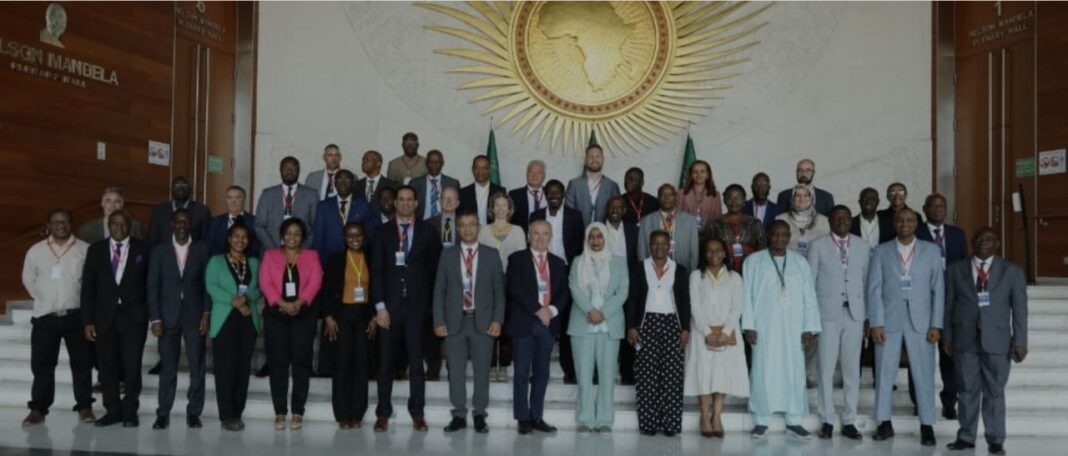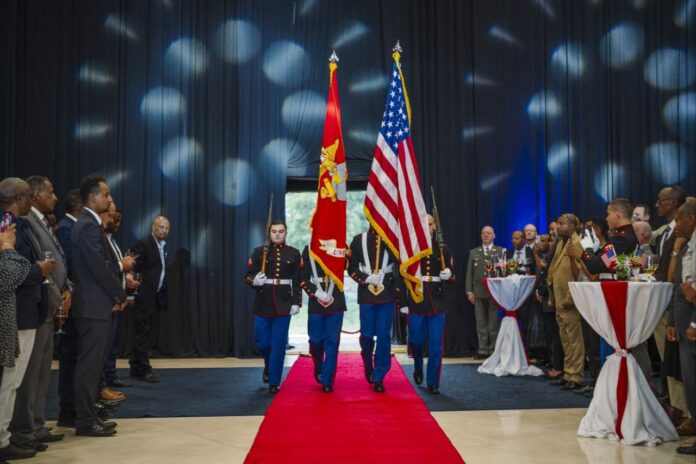
The United States Embassy in Addis Ababa, alongside the U.S. Mission to the African Union and the Office of Sudan Affairs, marked the 250th anniversary of American independence with a high-level reception at the Science Museum on July 2.
The event brought together senior Ethiopian government officials, African Union (AU) representatives, diplomats, and invited guests, highlighting both the United States’ 250-year history and more than a century of diplomatic relations with Ethiopia.
U.S. Ambassador to Ethiopia Ervin Massinga opened the समारोह by emphasizing the strength and future of bilateral ties. “We gather tonight not just to celebrate American independence, but to celebrate the deep, enduring, and forward-looking partnership between the United States and Ethiopia,” he said.
Ambassador Massinga pointed to recent economic and diplomatic developments, commending Ethiopia’s ongoing market reforms and efforts to improve the business climate. He praised the Ministry of Finance for advancing policies aimed at creating a more predictable and open investment environment, noting that such reforms could unlock the country’s technological and commercial potential.
He also highlighted key economic milestones, including the opening of Ethiopia’s banking sector to foreign investors and the launch of the Ethiopian Securities Exchange with U.S. support. According to the ambassador, these initiatives reflect Washington’s broader approach to commercial diplomacy, focused on expanding trade and private-sector partnerships.
On the health front, Massinga referenced a major bilateral agreement signed in December 2025, under which the United States committed more than `$1 billion over five years to health cooperation, complemented by an additional $450 million pledged by Ethiopia. He described the agreement as a model of co-investment under the U.S. global health strategy.
Walter Parrs, Chargé d’Affaires ad interim at the U.S. Mission to the African Union, underscored Washington’s collaboration with the AU on peace and security, public health, and economic development. He emphasized the importance of a “partnership of equals” and noted the role of U.S. private sector investment in supporting infrastructure and technological advancement across the continent.
Parrs also highlighted joint efforts in addressing regional conflicts, including in eastern Democratic Republic of Congo and Sudan, and commended the Africa Centres for Disease Control and Prevention (Africa CDC) for its coordination with U.S. institutions in responding to Ebola outbreaks this year.
“As I look toward America’s next 250 years, I see a future in which the United States is connected in more and stronger ways to this continent,” Parrs said. “We enter this next chapter as equal partners, proud of how far we have come and fully committed to the work ahead.”
Ambassador Massinga also stressed Africa’s growing global economic importance, describing the continent as a future engine of growth, with Ethiopia playing a leading role. He also underscored the importance of peace and stability, referencing ongoing African Union mediation efforts in northern Ethiopia.
Quoting U.S. Secretary of State Marco Rubio, Massinga noted that “peace is not a noun, it is a verb,” calling for continued engagement to sustain stability and development.
He concluded with a forward-looking message, urging deeper cooperation in building “a safer, stronger, and more prosperous” future for both nations and the wider global community.