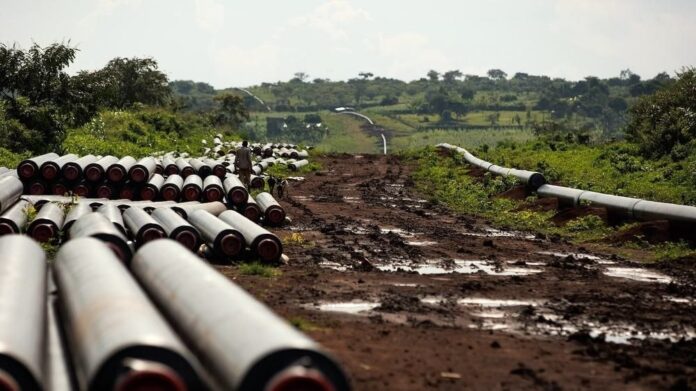
Despite years of international and local opposition, the construction of a highly controversial 900-mile (1,448-kilometer) oil pipeline in East Africa has reached its final stages.
The massive project, known as the East African Crude Oil Pipeline (EACOP), is expected to begin operations within weeks. Consequently, the severe environmental and social risks it poses to the region’s ecosystem and local communities are now coming into sharp focus. Environmental campaigners in Uganda and abroad are making an eleventh-hour legal push to halt the project before the oil begins to flow.
The primary epicenters of this project are located within Uganda’s renowned Murchison Falls National Park. The French energy giant TotalEnergies is preparing to launch production at the Tilenga oil field situated inside the park. This national park is one of Africa’s most spectacular wildlife havens—serving as Uganda’s last stronghold for around 240 lions, a critical corridor for elephant migration stretching into South Sudan and the Democratic Republic of the Congo (DRC), and a vital habitat for giraffes, buffalo, crocodiles, and hippos.
A second oil field, the Kingfisher project, is operated by China’s CNOOC on the eastern shores of nearby Lake Albert. Crude oil from both fields will be transported to international markets via the pipeline, which stretches across neighboring Tanzania to a port on the Indian Ocean, making it the world’s longest electrically heated oil pipeline.
Environmental experts note that by failing to adopt industry best practices, the companies have caused unnecessary destruction inside the park, including clearing vegetation and building 24 miles of new roads. As a result, wildlife fleeing the noise and heavy machinery have encroached on nearby villages, trampling crops and resulting in human casualties.
As one environmental conservation group reported “Where there were once unbroken vistas of savannah and roaming herds, there are now freshly bulldozed roads, fenced-off well pads, and the faint gleam of an oil rig’s lights on the horizon.”
While the project initially faced severe funding bottlenecks after a sustained campaign successfully pressured major international banks and insurers to withdraw support, it ultimately moved forward with financing backed by South Africa’s Standard Bank and the Industrial and Commercial Bank of China (ICBC).
However, the displacement of over 100,000 local residents along the pipeline route, coupled with inadequate compensation and the targeting of activists, has sparked intense outcry.
Over the past few years, local environmental and human rights defenders speaking out against the pipeline have faced intimidation, beatings, and arbitrary detentions by security forces. Compounding these fears, the Ugandan government recently enacted a new Protection of Sovereignty Act, which criminalizes the promotion of “foreign interests” in domestic politics—a move local civil society organizations fear could be used to hand down long prison sentences to environmental activists.
In response to this hostile environment, opponents and human rights lawyers are preparing to file a legal injunction in London, where EACOP Ltd is registered. The core of their legal challenge will argue that allowing the pipeline to operate directly breaches Uganda’s national environmental laws and its constitution.
Over its projected 25-year lifespan, the burning of the oil transported by this pipeline is estimated to generate roughly 379 million metric tons of carbon dioxide (CO_2). This total is equivalent to more than 40 years of Uganda’s current domestic emissions.