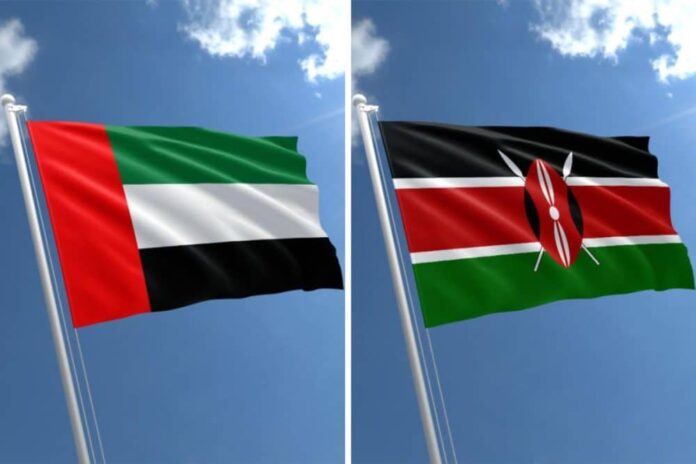
Kenyan President William Ruto and UAE President Sheikh Mohamed bin Zayed Al Nahyan have agreed to immediately fast-track the implementation of the Comprehensive Economic Partnership Agreement (CEPA), a deal expected to transform the economic landscape of East Africa. During high-level talks held at the Presidential Palace on April 22, 2026, the two leaders described the agreement as a pillar for a new “strategic alliance” between the two nations.
Signed in early 2025 and having undergone rigorous review by the Nairobi legislative council, the CEPA goes beyond traditional trade exchange. According to information from the delegation, the framework of this agreement aims to eliminate tariff barriers and streamline the flow of goods between the Port of Mombasa and the logistics hubs of the United Arab Emirates.
Sources closely monitoring the discussions noted that “this is not just a trade agreement, but a practical tool for restructuring the supply chain.” The deal provides opportunities for Kenyan education, transport, and technology service providers to enter the Gulf market while boosting UAE investment in Kenya’s digital economy.
The stability of Kenya’s energy sector was a major agenda item during the leaders’ discussion. Under the current agreement between the two governments, Kenya imports up to 810,000 metric tonnes of petroleum products monthly from the UAE and Saudi Arabia. It was noted that the Abu Dhabi National Oil Company (ADNOC) and Emirates National Oil Company (ENOC) are key partners in providing a reliable fuel supply to Kenya.
Beyond fuel, the leaders discussed transitioning to green energy. President Ruto stated during the summit that “the foundation of our future partnership is based on sustainability.” A new commitment was shown to undertake large-scale renewable energy projects and infrastructure construction using the UAE’s technical expertise and Kenya’s vast geothermal and solar energy potential.
The leaders’ summit also had significant geopolitical implications. President Ruto reaffirmed that Kenya strongly condemns the recent attacks on civilian infrastructure in the Gulf region. Describing the attacks as a “violation of national sovereignty and international law,” the President pointed out that such actions are a direct threat to international maritime security and global economic stability.
In an era where instability in the Red Sea region is impacting trade routes, the alignment between Nairobi and Abu Dhabi is seen as a strategic step to protect the “gateway to East Africa.” The leaders addressed the dire consequences of regional instability, emphasizing that the success of the CEPA is tied to the safety of international shipping.
As 2026 progresses, the focus shifts from diplomatic signatures to practical results. The Kenyan Ministry of Trade is strengthening its efforts to export products to the Gulf countries. Data from January 2026 shows that Kenya’s total export trade has grown by 11.6 percent compared to the same period last year. The presence of high-ranking officials, including Sheikh Hamdan bin Mohammed bin Zayed Al Nahyan, at the summit demonstrates the great importance both countries place on the partnership.