Authorities in Khartoum, Sudan’s capital, have issued an urgent safety warning to civilians returning to their homes. Following an explosion caused by a buried weapon in the eastern part of the city, residents have been urged to refrain from burning waste in their neighborhoods.
This blast has clearly demonstrated that unexploded remnants of war (ERW) still pose a lethal threat within the city’s residential blocks.
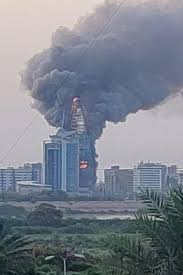
The incident occurred on Friday night in the neighborhood known as Nasir Extension. According to government officials, the explosion was triggered when residents collected and burned waste directly over a site where a large piece of ordnance was buried.
The blast produced a massive sound heard in distant neighborhoods, causing significant panic among a population that has already endured immense suffering during the conflict.
Major General Khalid Hamdan, Director of Mine Action, stated that specialized technical teams were immediately deployed to the area. “Preliminary investigations suggest the blast was caused by an old 130mm or 155mm rocket or shell that failed to detonate during previous combat,” the General told the Sudan Tribune.
He explained that the intense heat generated by the burning trash reached the buried device underground, causing it to ignite.
Although the explosion caused no casualties or property damage, security forces cordoned off the area for several days to ensure no additional explosives remained. Khartoum Governor Ahmed Osman Hamza visited the site immediately after the incident to oversee precautionary measures. The Governor issued a strict directive for citizens to exercise extreme caution, particularly those living in areas previously occupied by the Rapid Support Forces (RSF).
The neighborhoods of Eastern Khartoum were the site of intense ground battles, airstrikes, and drone attacks starting in April 2023. Although the Sudanese army regained control of the state in March 2025, unexploded weapons remain a “silent” threat that hinders the return to a fully peaceful life.
UN Humanitarian Coordinator Denise Brown stated that “mine action is an urgent humanitarian necessity,” warning that the spread of explosive contamination is currently outpacing clearance efforts, obstructing humanitarian aid and endangering lives daily.
As authorities work to restore basic services such as water, electricity, and education, the increasing number of returning residents has made de-mining efforts even more urgent. General Hamdan noted that while mines are typically found on transit routes, the Nasir Extension incident proves that heavy ordnance can be buried even within residential villages.