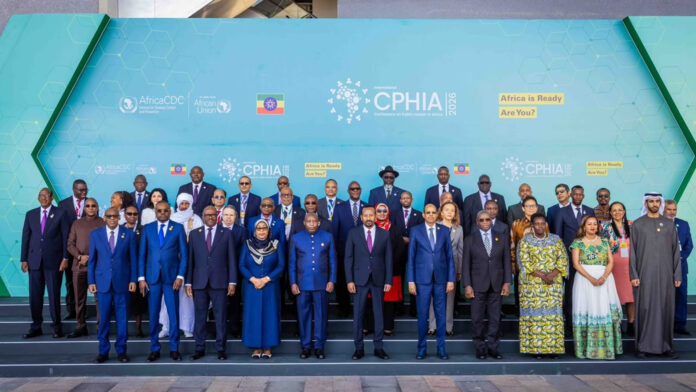
The Fifth International Conference on Public Health in Africa (CPHIA 2026) concluded on Friday, November 27, 2026, in Addis Ababa, with African governments and global health partners unveiling major commitments to strengthen domestic health financing, expand local pharmaceutical manufacturing, and assert continental leadership in global health governance. Co-hosted by the Africa Centres for Disease Control and Prevention (Africa CDC) and the Government of Ethiopia under the theme “Africa’s Health Security and Sovereignty: Transformation from Health Dependency and Vulnerability to Ownership and Resilience,” the five-day gathering marked the largest public health convening in the continent’s history.
Held at the Addis International Convention Centre, the conference drew 29,000 in-person delegates alongside 270,000 virtual participants from 135 countries. Among those in attendance were six Heads of State and Government, 63 ministers, researchers, manufacturers, and youth advocates. In a historic first for global health diplomacy, all seven candidates vying to become the next Director-General of the World Health Organization participated in a dedicated dialogue on an African platform, signaling a shift in which African nations actively set global health priorities rather than remaining passive recipients of external agendas.
The urgency of the summit was underscored by declining international health assistance and active public health emergencies across the continent, including the ongoing Bundibugyo Ebola outbreak in the Democratic Republic of Congo. To counter shrinking donor aid, delegates unveiled “The Addis Commitments,” a comprehensive framework centered on self-reliance and measurable accountability.
Domestic resource mobilization and local manufacturing anchored the conference’s financial pledges. The Central African Republic committed to more than doubling its health budget allocation from roughly 4% in 2026 to 10% by 2029, accompanied by quarterly expenditure reporting. Meanwhile, Ghana announced a landmark US1 billion investment over four years to develop pharmaceutical and biomanufacturing hubs, and authorized the direct procurement of locally produced snake antivenom.[span_5](end_span) In Southern Africa, Zambia broke ground on a cholera vaccine manufacturing plant slated to begin fill-and-finish operations within a year. [span_6](start_span)To streamline purchasing power, Sudan, South Sudan, and Botswana formally joined the African Pooled Procurement Mechanism, while five Southern African Development Community nations entered a regional pooled procurement arrangement projected to save US200 million.
Responding to immediate health crises also took center stage. Member States prioritized rebuilding Sudan’s war-ravaged health system, where Health Minister Dr. Haitham Mohammed Ibrahim appealed for support to close an annual funding gap of at least US700 million over the next three years. Africa CDC pledged technical backing to restore Sudan’s emergency operations, genomic sequencing, and laboratory networks. [span_7](start_span)Simultaneously, addressing the continental Bundibugyo Ebola response—which requires an estimated US1.576 billion over six months—Gavi announced an advance purchase commitment for up to 1.5 million doses of a Bundibugyo vaccine, contingent on Phase 3 trial outcomes.
Beyond emergency response, leaders launched long-term structural initiatives. Tanzanian President Samia Suluhu Hassan introduced a continental roadmap targeting zero preventable maternal and newborn deaths, supported by US$665 million from The Beginnings Fund across 14 nations. Ethiopian Prime Minister Dr. Abiy Ahmed unveiled a continental roadmap for artificial intelligence and digital health, alongside plans for a pan-African AI university in Ethiopia.