The European Union (EU) has committed 20 million euros to a new four-year partnership with the governments of Ethiopia, Djibouti and Somalia and TradeMark Africa (TMA) to strengthen digital, green and efficient trade systems across the Horn of Africa.
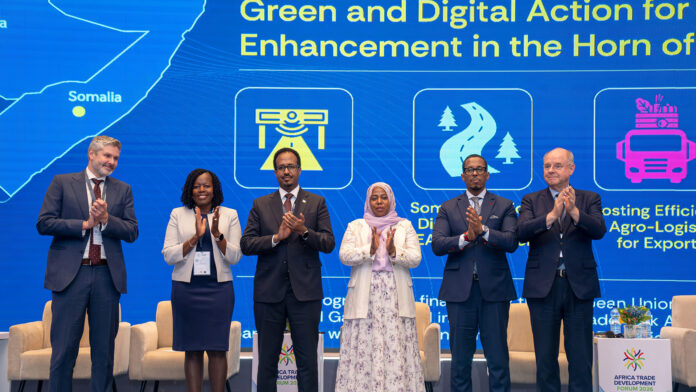
The programme, Global Gateway Corridor Action: Green and Digital Action for Trade and Transport Enhancement in the Horn of Africa, was signed and launched on the sidelines of the Africa Trade and Development Forum (ATDF) 2026 in Addis Ababa.
It will support more efficient, digital and sustainable trade systems, helping reduce trade costs, strengthen regional integration and expand businesses’ access to regional and international markets.
TMA will implement the programme, focusing on digital trade and transport systems, agricultural export logistics, greener freight and regional trade integration.
Financed under the EU’s Global Gateway strategy, the partnership brings Ethiopia, Djibouti and Somalia together around shared priorities of efficient cross-border trade, sustainable connectivity and economic competitiveness.
It builds on the ongoing 32-million-euro EU-funded Djibouti-Ethiopia corridor programme, which handles 95 percent of Ethiopia’s import-export trade by volume. The new initiative also aligns with the African-led Horn of Africa Initiative and supports the African Continental Free Trade Area (AfCFTA), while advancing Somalia’s integration into regional and international trading systems.
The signing was witnessed by Ethiopia’s Minister of Trade and Regional Integration, Yasmin Wohabrebbi; Djibouti’s Minister of Commerce and Tourism, Orbis Helaf Orbis; and Somalia’s Minister of Commerce and Industry, Gamal Hassan.
Daniel Hachez, head of partnerships at the EU Delegation to Ethiopia, said the Horn of Africa’s economic potential depends on stronger links between its countries, markets and businesses.
“Through Global Gateway, the European Union is working with Ethiopia, Djibouti and Somalia to advance sustainable connectivity and regional integration,” he said. “Building on our cooperation with TradeMark Africa along the Djibouti-Ethiopia Corridor, this new investment extends that partnership across the region, making regional trade more efficient and sustainable.”
Celestine Munda, TMA vice board chair, said a trade corridor works only when every part works together.
“Our experience along the Djibouti-Ethiopia Corridor shows that digital systems, regulatory reform and institutional cooperation must advance in step,” she said. “By uniting three governments and the European Union around a common regional agenda, this partnership equips us to tackle cross-border trade barriers, cut costs and make trade more predictable for businesses.”
The new investment builds on cooperation between the EU, the governments of Ethiopia and Djibouti, and TMA through the ongoing Djibouti-Ethiopia Corridor Programme, financed by the EU under Global Gateway, with funding delegated to Agence Française de Développement (AFD) and implemented by TMA in partnership with the two governments.
In Ethiopia, programme-supported electronic phytosanitary certification has enabled more than 80 exporters to exchange electronic certificates through an international network covering close to 110 countries.
Programme-supported export compliance measures have coincided with a reduction in False Codling Moth-related interceptions, from seven cases in 2023-24 to zero in 2024-25.
In Djibouti, user acceptance testing for the Electronic Cargo Tracking System has been completed across 13 monitoring zones and 12 cargo-control modules, while installation of the Control and Monitoring Centre is under way.
At Galafi, Ethiopia and Djibouti are advancing a joint roadmap towards a One-Stop Border Post, strengthening coordination between border agencies and facilitating cross-border trade.
The programme is also developing a Corridor Transport Observatory to monitor logistics performance and transport-related emissions. It has delivered logistics training aligned with the International Federation of Freight Forwarders Associations and capacity-building support for women traders.
The new programme will broaden this cooperation into a regional framework spanning Ethiopia, Djibouti and Somalia, linking national trade reforms to shared priorities in digital interoperability, efficient transport and sustainable logistics.
Working with governments, trade institutions and the private sector, it aims to lower the cost and uncertainty of cross-border trade, make supply chains more reliable and help businesses compete in regional and international markets.