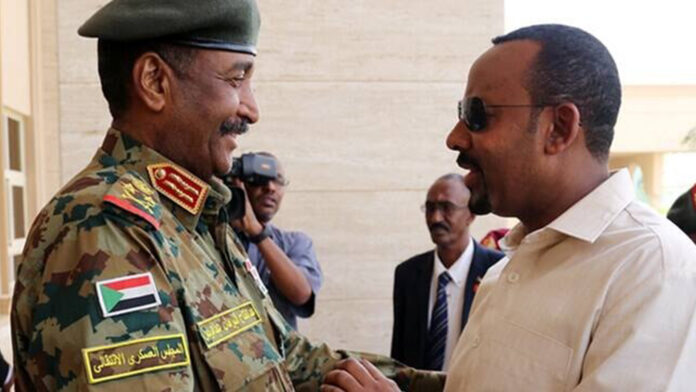
Ethiopia has invited Sudan’s military, political and civilian factions to participate in an inclusive national dialogue in Addis Ababa, offering to facilitate negotiations aimed at ending the country’s four-year conflict and restoring peace and stability.
In a statement issued by Prime Minister Abiy Ahmed, the Ethiopian government called on all Sudanese stakeholders to engage in comprehensive negotiations, pledging to provide an impartial platform for discussions on a permanent ceasefire, the formation of an inclusive government of national unity and the restoration of Sudan’s sovereignty and stability.
Abiy described Ethiopia’s initiative as a responsibility rooted in the longstanding historical, social, cultural and human ties between the two neighboring countries, emphasizing that the suffering of the Sudanese people cannot be viewed as an issue affecting only a neighboring state.
“What Sudan is witnessing in terms of war, destruction, and human suffering cannot be regarded by us merely as a political or security development in a neighboring country,” Abiy said.
“Rather, it is a wound that touches the conscience of the Ethiopian people, calling upon us to take a responsible stance based on brotherhood, solidarity, and a sincere commitment to Sudan’s peace, security, unity, and stability,” he added.
The initiative comes as Sudan continues to grapple with a devastating conflict that began on April 15, 2023, between the Sudanese Armed Forces (SAF) and the paramilitary Rapid Support Forces (RSF). The fighting has triggered widespread displacement, a major humanitarian emergency and extensive destruction of public infrastructure.
Ethiopia acknowledged that the continuation of the conflict poses serious security and economic challenges to the wider Horn of Africa but stressed that its primary concern is the right of the Sudanese people to live in dignity and determine their political future without external interference.
The latest diplomatic initiative also builds on Ethiopia’s previous involvement in Sudanese political negotiations, particularly its mediation efforts following the 2019 December Revolution.
At the time, Ethiopia played a role in facilitating negotiations between Sudan’s Transitional Military Council and civilian representatives of the Forces of Freedom and Change, contributing to a power-sharing agreement that established a transitional political arrangement.
Abiy said Ethiopia remained committed to supporting a peaceful resolution, emphasizing that a stable and unified Sudan is essential for regional security and cooperation.
The proposed dialogue framework identifies several priorities, including maintaining Ethiopia’s impartiality toward Sudanese political and military factions, securing an immediate cessation of hostilities, building consensus on an inclusive transitional government and ensuring that any political settlement is owned and led by Sudanese stakeholders.
The government said Ethiopia would act strictly as a facilitator, maintaining equal distance from the competing parties and avoiding any political agenda of its own.
It also emphasized the need to create conditions for ending active fighting, rebuilding state institutions and establishing a government capable of representing Sudan’s diverse political and social groups.
The proposal further rejects externally imposed political settlements, arguing that a lasting solution must emerge from negotiations among Sudanese stakeholders and reflect the country’s national interests and diversity.
“The goal is not the victory of one party over another, but the victory of Sudan, the restoration of the state, the cessation of bloodshed, and the opening of a path toward a future that embraces all its citizens,” the statement said.
Beyond the proposed negotiations, Ethiopia called on the international community, regional organizations and partner countries to increase humanitarian assistance for millions of Sudanese affected by the conflict.
Abiy urged international actors to support genuine peace initiatives and avoid political divisions that could further complicate efforts to end the war.
Ethiopia reaffirmed its readiness to mobilize its diplomatic relations and regional partnerships in support of the proposed talks, calling on Sudanese leaders to put the interests of their country and people above competing political and military objectives.
“Sudan deserves peace, its people deserve life and dignity, and its future must be forged by its own sons and daughters,” Abiy said.
The Ethiopian government reiterated its commitment to supporting genuine efforts to transform dialogue into a lasting political settlement, stressing that Sudan’s future should be determined by its own people.