Ethiopia and Djibouti have engaged in high-level discussions aimed at significantly improving port productivity, transport corridor efficiency, and trade facilitation. The diplomatic and strategic engagement underscores the deep economic interdependence between the two nations, particularly regarding Ethiopia’s reliance on Djibouti as its primary maritime gateway for international trade.
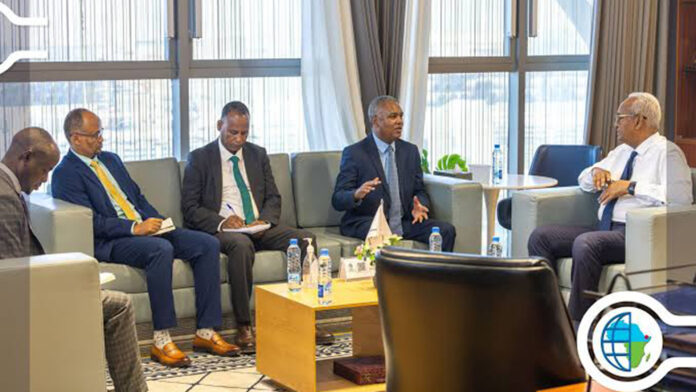
The talks took place on November 22, 2026, at the Red Sea World Centre. During the meeting, Djibouti Ports and Free Zones Authority (DPFZA) Chairman Omar Hadi welcomed Ethiopian Ambassador to Djibouti Legesse Tulu Adera alongside a delegation of senior embassy officials. The discussions centered on addressing critical operational bottlenecks, improving ship-to-shore efficiency, and accelerating cargo movement at the Doraleh Multipurpose Port (DMP). Both sides placed special emphasis on reducing vessel turnaround times by leveraging alternative port and transport routes.
A major focal point of the meeting was the utilization of Tadjourah Port and the Tadjourah-Balho corridor. Officials noted that these alternative pathways can substantially alleviate vessel waiting times and streamline logistics. Tadjourah Port, which features a depth of 14.5 meters at low tide, is already actively serving industries located in Dire Dawa, demonstrating its capacity to absorb regional cargo demand.
Operational readiness ahead of seasonal shifts was another critical topic on the agenda. The delegations discussed improving traffic and logistical operations along the vital Djibouti-Galafi (RN1) road corridor and at DMP ahead of Ethiopia’s upcoming main rainy season, locally known as kiremt. Highlighting the stakes for food security and agriculture, the DPFZA noted that 2.4 million tons of fertilizer had successfully been delivered on time ahead of the previous main rainy season, emphasizing how vital reliable port and transport operations are to Ethiopia’s agricultural supply chain.
Beyond physical infrastructure, the discussions tackled regulatory and labor conditions. The two sides reviewed the newly introduced road-fee payment system implemented by Djibouti’s road authority, DPCR. They also addressed the working conditions of Ethiopian truck drivers operating along the corridor, as well as the administrative and legal procedures governing commercial transactions and the physical delivery of goods through Djibouti’s free zones. Specifically, the talks covered the need to fine-tune Cost, Insurance, and Freight (CIF) arrangements, focusing on the commercial, physical delivery, and financial transaction components of bilateral trade.
These cooperative efforts unfold against the backdrop of Djibouti maintaining its position as Ethiopia’s principal maritime outlet, even as Addis Ababa pursues long-term diversification strategies. According to Denge Boru, State Minister of Transport and Logistics, Ethiopia handled approximately 17.57 million tons of import and export cargo during the 2025/26 fiscal year. Djibouti retained an overwhelmingly dominant share, with its ports handling roughly 15.34 million tons. Alternative gateways—such as Berbera, Tadjourah, and the Mombasa-Moyale corridor—currently manage considerably smaller volumes.
Modal distribution for freight movement remains heavily skewed toward road transport. During the same fiscal year, road transport accounted for approximately 80.15% of Ethiopia’s freight movement, while the Ethio-Djibouti railway carried 18.92%, highlighting the ongoing economic importance of the shared road corridor.
Ethiopia’s deep reliance on neighboring ports dates back to the loss of its direct access to the Red Sea following Eritrea’s independence in 1993, a dependence that was cemented after the 1998–2000 conflict severed its use of the Eritrean ports of Assab and Massawa. With Djibouti serving as the nation’s indispensable maritime lifeline, ongoing diplomatic and logistical collaboration remains central to securing Ethiopia’s economic future.