United Nations Secretary-General António Guterres has called on developed countries to urgently translate their climate finance commitments into concrete funding, warning that vulnerable nations cannot continue bearing the growing costs of climate change without adequate international support.
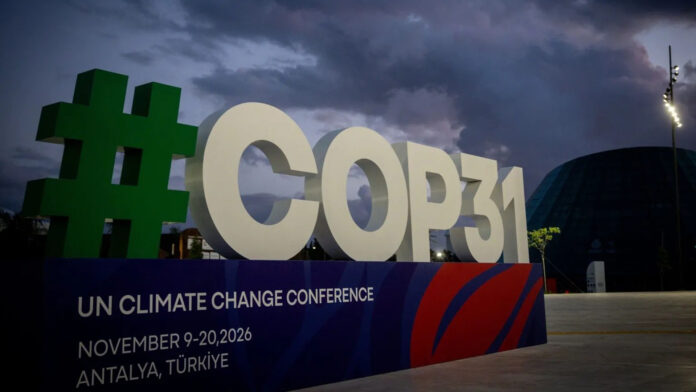
Guterres made the appeal following the conclusion of the 31st United Nations Climate Change Conference (COP31) in Antalya, Türkiye, which ended on November 22 without agreement on an overarching political outcome after prolonged negotiations exposed deep divisions among participating countries over climate finance and the future of fossil fuels.
Expressing deep disappointment over the failure to reach consensus, the UN chief said the absence of a political agreement would not change the scientific reality of the climate crisis or reduce the urgency of global action.
“There may be no consensus in the negotiating room. There is no ambiguity in the science,” Guterres said in his statement following the conclusion of the summit.
He warned that global temperatures continue to break records, while extreme weather events are becoming more frequent and destructive. The world is also approaching a dangerous overshoot of the internationally agreed 1.5-degree Celsius temperature threshold, leaving governments with an increasingly narrow opportunity to limit the duration and scale of that overshoot.
At the centre of Guterres’s appeal was the need for developed economies to fulfil their financial responsibilities towards developing countries, which are often among the most exposed to climate-related disasters despite contributing relatively little to global greenhouse gas emissions.
“Put dates and dollars behind that pledge now. Lives depend on it,” he urged, calling on wealthy nations to honour their commitments to significantly increase adaptation financing.
He added that countries that have contributed least to the climate crisis should not be left to face its most severe consequences without international assistance.
The demand comes amid a substantial gap between the resources developing countries require to protect their economies and communities from climate impacts and the funding they currently receive.
According to figures presented during the opening of COP31 by the President of the UN General Assembly, developing countries require as much as 305 billion dollars annually for climate adaptation, while current financial support stands at approximately 26 billion dollars.
The financing gap is particularly significant for countries facing recurring droughts, floods, water shortages, agricultural disruptions and other climate-related challenges. For many developing economies, inadequate adaptation funding limits their ability to strengthen infrastructure, protect agricultural production, improve early-warning systems and build resilience among vulnerable communities.
The issue has remained a major point of disagreement in international climate negotiations. Under the Glasgow Climate Pact adopted at COP26 in 2021, developed countries were urged to double adaptation finance by 2025. However, the commitment has not been fully achieved, while developing nations have continued demanding clearer financial targets and delivery mechanisms for subsequent years.
Negotiations in Antalya were originally scheduled to conclude on November 20 but continued for nearly 50 additional hours as countries attempted to bridge disagreements over the final agreement.
The negotiations eventually broke down after countries failed to agree on the proposed Antalya Pact. Two major issues dominated the discussions: whether the final agreement should explicitly commit countries to transitioning away from fossil fuels and how much financial assistance wealthy nations should provide to developing economies for climate adaptation.
A revised draft agreement reportedly removed references to fossil fuels and dropped a proposed target of providing 120 billion dollars annually for adaptation finance by 2035. The changes triggered criticism from the European Union, small island nations and environmental organisations, which argued that the proposed text weakened the ambition of international climate commitments.
The European Union ultimately refused to support the proposed agreement. Ireland’s Climate Minister Darragh O’Brien described the absence of any reference to fossil fuels in a climate agreement as unacceptable.
Beyond the financing dispute, Guterres also criticised the continued dependence on coal, oil and natural gas, arguing that fossil fuel consumption remains the principal driver of global warming.
He accused powerful fossil fuel interests of using tactics similar to those employed by the tobacco industry to undermine scientific evidence, delay government action and protect commercial interests.
“We can’t put out the fire while pouring fuel on it,” he said, urging governments to accelerate the transition towards cleaner energy systems.
Guterres called for countries to implement the commitment to transition away from fossil fuels agreed at COP28 in Dubai and to advance clean energy development, modernise electricity grids, reduce methane emissions and restore forests.
He also highlighted the importance of expanding the UN’s Early Warnings for All initiative, which seeks to ensure that communities worldwide have access to timely information and early-warning systems to protect lives against extreme weather events.
The failure to secure an overarching agreement at COP31 reflects continuing disagreements between developed and developing countries over responsibility, financing and the pace of the global energy transition.
Developing countries have consistently argued that wealthy industrialised economies should provide greater financial and technological assistance because of their historical contribution to greenhouse gas emissions. Many vulnerable nations also maintain that climate commitments must be supported by predictable funding rather than broad political promises.
Although the summit failed to produce a comprehensive political agreement, participants adopted several technical decisions covering adaptation, just transition and the Adaptation Fund, indicating that cooperation on specific climate issues can continue despite broader diplomatic disagreements.
In his concluding remarks, Guterres thanked Turkish President Recep Tayyip Erdoğan, COP31 President Murat Kurum and President of Negotiations Chris Bowen for their efforts to facilitate the discussions.
He also called on civil society organisations, young people, Indigenous communities, scientists and populations directly affected by climate change to maintain pressure on governments and businesses to deliver stronger climate action.