An international team of scientists led by the University of Bristol has solved a perplexing geological mystery after satellite observations revealed that Ethiopia’s Fentale Volcano released a record-breaking surge of methane without actually erupting. According to research published in Nature Geoscience, an underground sheet of magma ruptured an impermeable rock layer, unleashing vast reserves of trapped greenhouse gases in a previously undocumented natural phenomenon.
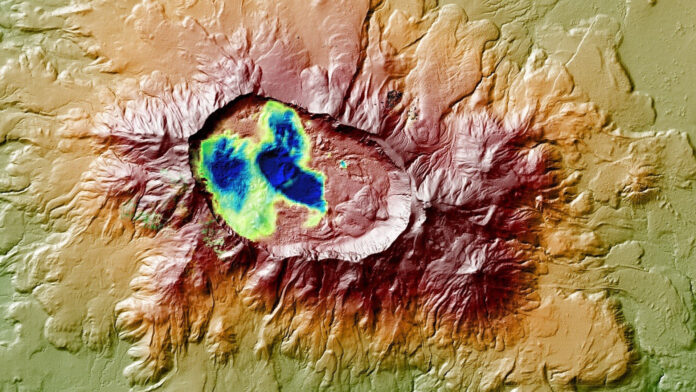
Between December 2024 and March 2025, space-based sensors detected Fentale Volcano emitting at least 38 kilotonnes (roughly 38,200 tonnes) of methane over a three-month span. Situated in the East African Rift approximately 100 kilometers east of Ethiopia’s capital, Addis Ababa, Fentale produced the first confirmed volcanic methane outburst of this scale ever recorded. The emission rate was roughly four orders of magnitude higher than typical volcanic systems and rivaled the output of a major industrial gas blowout. Alongside the methane, the volcano expelled at least 2.9 megatonnes of carbon dioxide during the same timeframe—an extraordinary volume for a volcano that never breached the surface with lava.
The mystery began when researchers monitoring seismic unrest around Fentale were alerted by carbon-monitoring specialists at GHGSat and the Space Research Organisation Netherlands (SRON), who spotted massive gas plumes drifting from the volcano’s caldera on satellite imagery. To uncover what was happening beneath the surface, lead author Dr. Edna Dualeh, a Senior Research Associate in the University of Bristol’s School of Earth Sciences, and her colleagues combined atmospheric gas measurements with thermal, optical, and synthetic aperture radar (SAR) data.
Their reconstruction revealed that a “mega-dyke” intrusion—a massive, vertical sheet of molten rock forcing its way through fractures in the stretching continental crust—propagated underground starting in mid-December 2024. Although roughly one cubic kilometer of magma remained trapped beneath the surface rather than erupting, its movement physically disrupted an impermeable geological cap. Beneath that seal lay hydrocarbon-rich sediments holding vast quantities of methane. Once punctured, the pressurized gas escaped rapidly into the atmosphere, accompanied by localized ground subsidence and thermal anomalies inside the crater.
“The observation of a methane outburst from a volcano was a complete surprise,” Dr. Dualeh said. “It’s brilliant that we were able to bring together so many types of observations and collaborators to understand the source of the methane.”
While 38 kilotonnes of methane represents only a fraction of present-day annual global emissions and will not measurably alter today’s climate trajectory, the discovery carries major implications for understanding Earth’s deep past. Historically, volcanoes have been viewed as negligible contributors to atmospheric methane. However, previous unanalyzed data suggests the East African Rift maintains higher background methane levels than other volcanic regions, indicating that rift volcanoes interacting with sedimentary basins may be uniquely prone to episodic gas releases.
Scientists view the Fentale episode as a modern, small-scale analog for Large Igneous Provinces (LIPs)—colossal prehistoric volcanic events where magma intruded through carbon- and hydrocarbon-rich rock layers, triggering sudden, catastrophic global warming.
“The episode at Fentale revealed the potential for large, episodic emissions of greenhouse gases from rift volcanoes – something that is not accounted for in the natural atmospheric methane budget, volcanic hazard assessments, or climate models,” Dr. Dualeh concluded, underscoring the need for expanded satellite and ground monitoring across active rift zones.