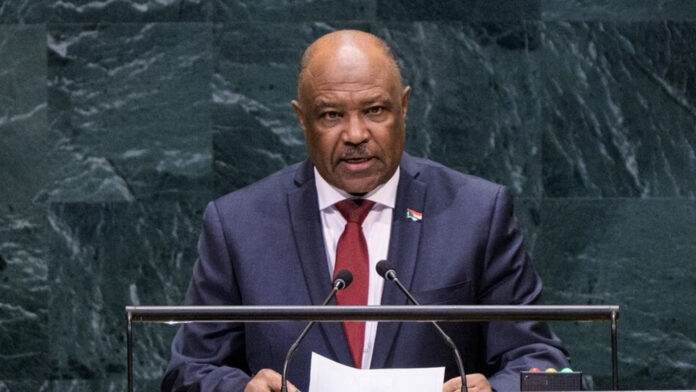
Addressing the 81st session of the United Nations General Assembly, Sudanese Foreign Minister Mohieldin Salim Ahmed Ibrahim delivered a sharp rebuke against external interference in his country’s ongoing conflict. He forcefully urged the international community to choke off the steady stream of weapons, ammunition, and foreign fighters fueling the war, while categorically rejecting any external attempts to impose solutions on the Sudanese people.
Minister Salim took the global stage in place of the de facto head of state, Sudanese Armed Forces (SAF) Commander and Sovereignty Council President Lt Gen Abdelfattah El Burhan. El Burhan’s planned attendance was blocked after his US visa application was rejected—a development Salim labeled as “deeply regrettable” and a breach of host-country obligations under the UN Headquarters Agreement, calling on the UN to formally examine the incident.
“We reaffirm Sudan’s openness to any sincere and constructive effort aimed at ending the war imposed on its people,” Salim stated during his address. “At the same time, we reiterate our categorical rejection of any attempt to impose solutions, dictates or external agendas upon our people”.
The Foreign Minister heavily criticized international sanctions levied against Sudan over the years, arguing that they have severely damaged the nation’s economy and sovereignty while exacerbating cycles of violence and obstructing genuine national reconciliation. Instead of outside dictates, Salim advocated for an inclusive, Sudanese-led political dialogue designed to tackle the root drivers of the conflict.
Shifting focus to the ground realities of the war, Salim leveled severe accusations against the paramilitary Rapid Support Forces (RSF), blaming them for widespread atrocities, targeting civilians, and assaulting medical facilities. He fiercely criticized international actors for failing to secure cross-border supply lines.
“Silence regarding the atrocities committed by the terrorist militia is not only shameful, unethical and complicit, it is a betrayal of the civilian victims,” Salim declared. He additionally called for strict accountability for crimes perpetrated across Darfur, Kordofan, and Blue Nile, alongside rigorous pressure on foreign governments accused of backing the RSF.
The UN session exposed deep regional friction, marked by sharp verbal exchanges between Sudan, the United Arab Emirates, and Chad. Khartoum explicitly accused both the UAE and Chad of facilitating support for the RSF. While Chad maintained its stance of strict neutrality, the UAE strongly rejected the allegations, pushing instead for an immediate humanitarian truce and a comprehensive nationwide arms embargo. The UAE representative also raised counter-allegations referencing international reports about chemical weapon use by the SAF—claims that independent media outlets like Radio Dabanga have been unable to verify.
As diplomatic maneuvers continue, domestic stakeholders have weighed in on potential pathways to peace. Darfur governor Minni Minnawi voiced support for a humanitarian truce aimed at protecting vulnerable civilians. However, he issued a stern warning against leveraging any ceasefire to establish a parallel government or fracture the unity of the Sudanese state. Highlighting a staggering displacement crisis that has forced over eight million people from Darfur into refuge, Minnawi demanded that RSF units immediately vacate civilian infrastructure and withdraw entirely from urban centers.