
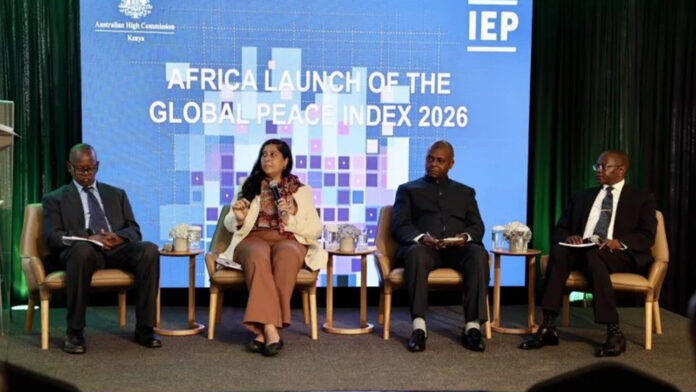
Kenya has secured a position of 132nd out of 163 countries in the newly released 2026 Global Peace Index (GPI), recording an improved score of 2.447. Published annually by the Institute for Economics and Peace (IEP) and launched locally at the Australia High Commission in Nairobi, the index highlights Kenya’s resilience amid mounting economic pressures and acute security volatility across East Africa.
However, the report underscores that Kenya remains heavily exposed to external conflicts, casting a spotlight on the delicate interplay between regional security, mounting debt, and national stability.
While Kenya’s score marks a positive shift, the broader sub-Saharan African region experienced a slight deterioration in peacefulness, with average scores worsening by 0.2 percent. Regionally, Kenya ranks 33rd among 44 sub-Saharan nations, trailing neighbors like Tanzania (98th), Rwanda (114th), and Uganda (130th), but remaining ahead of nations like Ethiopia, Nigeria, and Somalia.
The GPI report explicitly warns that the Horn of Africa can no longer be viewed as a collection of isolated disputes. Instead, it functions as an interconnected regional conflict system where crises in Sudan, Ethiopia, Eritrea, Somalia, and South Sudan bleed across borders via illicit economies, refugee movements, proxy alliances, and competition over strategic resources.
Furthermore, the index identifies Kenya among the countries involved in the highest number of external conflicts, participating in eight or more cross-border or regional security operations between 2020 and 2024. This active military and diplomatic footprint highlights Nairobi’s crucial role in regional peacekeeping, even as it exposes the country to cross-border spillover effects.
Beyond traditional security metrics, the 2026 index draws a sharp correlation between geopolitical instability and severe economic vulnerabilities for developing economies. The report singles out Kenya as particularly vulnerable to the global fallout of ongoing conflicts, such as the 2026 Iran war, which threatens to trigger spikes in energy prices, tighten financial conditions, and disrupt critical agricultural supply chains.
The IEP highlights a dangerous convergence of risk windows for Kenya in the second half of 2026. Gulf states supply roughly 45 percent of global sulphur and 50 percent of global urea; prolonged disruptions to these fertilizer markets are expected to heavily impact crop yields across East Africa heading into 2027.
Compounding these agricultural and food-price pressures is a looming fiscal wall. In November and December 2026, Kenya faces approximately $900 million in external debt maturities. The IEP warns that rolling over these sovereign debts at manageable rates could prove exceptionally difficult if global commodity shocks and regional conflicts persist, leaving the government with narrow fiscal breathing room.
Kenya’s slight domestic improvement contrasts sharply with a bleak global trajectory. The 2026 GPI reveals that global peacefulness declined by 0.7 percent, marking the 12th consecutive year of worldwide deterioration. Active state-based conflicts have climbed to post-World War II highs, resulting in more than 181,000 fatalities in violent conflicts during the previous year.