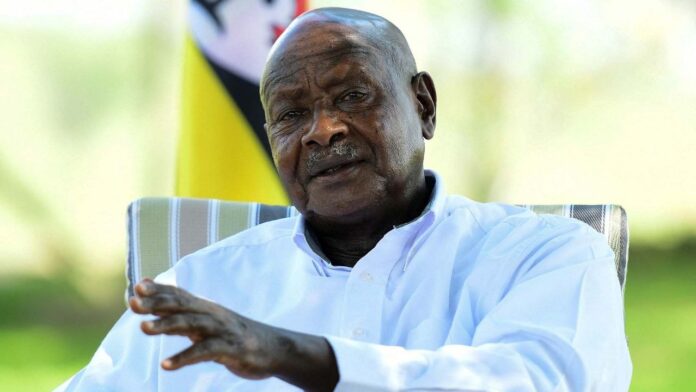
Ugandan President Yoweri Museveni has revealed that Uganda’s nearly two-decade military deployment in Somalia was driven primarily by solidarity with Ethiopia and opposition to regional religious extremism, rather than by a direct bilateral stake in Somalia’s internal stability.
Speaking at the Second Extraordinary Summit of Heads of State of Troop-Contributing Countries to the African Union Support and Stabilisation Mission in Somalia (AUSSOM) at the Speke Resort Munyonyo in Kampala, Museveni reflected on the foundational motives behind Uganda’s historic 2007 intervention.
“Uganda does not have a border with Somalia,” Museveni told the summit. “When, therefore, we decided to involve ourselves in Somalia, it was out of principle and strategy.”
The Ugandan leader cited two primary drivers for the military commitment: opposition to what he termed “Islamic chauvinism” spreading from Somalia and Sudan, and strategic solidarity with Ethiopia. Addis Ababa faced severe security threats linked to the region when its forces intervened in 2006 to remove the Islamic Courts Union from power in Mogadishu. Uganda subsequently became the first nation to deploy troops to Somalia in 2007 under the African Union Mission in Somalia (AMISOM), the direct predecessor to the current AUSSOM framework.
Museveni’s remarks coincided with a severe financial and operational crossroads for the peacekeeping coalition. Participants from Uganda, Ethiopia, Kenya, Djibouti, Egypt, and Burundi gathered to confront a looming funding crisis threatening the mission’s survival.
The United Nations Support Office in Somalia (UNSOS), which has provided vital logistics and operational backing for AU peacekeepers, is scheduled to end its mandate on December 31, 2026. This timeline follows a notification from the United States to the African Union on July 1 indicating it would not support a renewal of the mandate at the UN Security Council.
Gen. Muhoozi Kainerugaba, Uganda’s Chief of Defence Forces, addressed the military chiefs’ session, noting the gravity of the situation. “These are difficult circumstances, but they also call for our unity, creativity, and resolve,” he said, urging immediate preparations for an African-led alternative to UNSOS support.
Meanwhile, African Union Commission Chairperson Mahmoud Ali Youssouf reaffirmed the AU’s commitment to mobilizing the necessary diplomatic, political, and financial resources to sustain the mission. Somali President Hassan Sheikh Mohamud praised Museveni for convening the summit and hailed Uganda as a steadfast pillar for Somalia. However, friction bubbled beneath the surface; reports from Nairobi-based Sahan Research analyst Rashid Abdi indicated that President Mohamud successfully pressed to soften language regarding dialogue with Somali opposition figures in the summit’s final communique.
Museveni’s comments have triggered immediate backlash across Somali social media platforms. Many users and regional commentators characterized Ethiopia’s 2006–2009 military presence as an occupation rather than a stabilization mission, blaming it for thousands of civilian casualties, widespread property destruction, and severe human rights abuses.
Regional publications, including the Horn Review, labeled Museveni’s public framing a “diplomatic miscalculation.” Analysts warned that the admission exposes the instrumental nature of Uganda’s historical commitment just as Mogadishu seeks reassurance of a genuinely Somalia-centered partnership.
Security experts note that the timing of these remarks presents a dangerous propaganda windfall for Al-Shabaab. Researchers tracking the militant group’s recruitment methods have long documented its core narrative: that Somali government forces and foreign AU allies are external proxies rather than defenders of sovereignty.
Because Ethiopia’s 2006 invasion is widely viewed as a catalytic moment that birthed Al-Shabaab’s hardline nationalist wing, having a sitting head of state explicitly link a twenty-year deployment to that specific intervention hands the militant group potent, unforced narrative material. For Western capitals like Washington and Brussels—which have poured billions of dollars into building a stable, democratic, and secure Somalia free of Al-Shabaab—Museveni’s admissions complicate an already difficult fiscal calculus.
As donors weigh whether to continue underwriting a mission losing its UN logistics backbone at the end of the year, Museveni’s account raises probing questions. Analysts suggest that if key troop-contributors were never truly unified around Somalia’s native recovery and sovereignty goals, the true strategic outcome of nearly twenty years of sacrifices, billions of dollars, and thousands of lives remains deeply contentious.