The government of Djibouti has issued a robust and uncompromising rejection of any attempt to impose unilateral taxes, tolls, or transit fees on vessels navigating the vital Bab el Mandeb Strait. Warning that such measures would directly violate international law, the East African nation stressed that any interference with the strategic waterway threatens one of the world’s most critical maritime corridors for global trade and energy supplies.
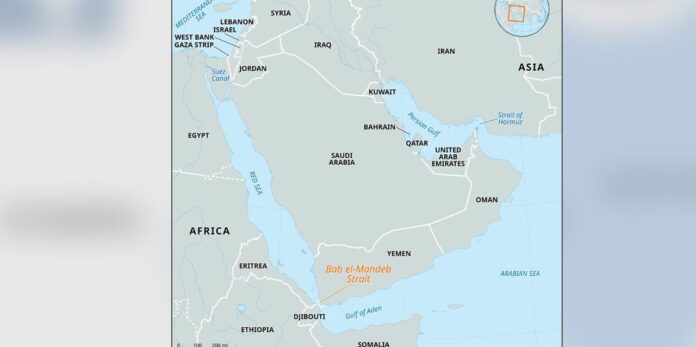
In an official statement released late Wednesday evening, the Djiboutian government voiced its strong opposition to any single party attempting to levy financial charges on commercial shipping using the shared waterway, which lies between the Horn of Africa and the western coast of Yemen.
The government’s declaration came in response to mounting reports earlier in the day indicating that Yemen’s Houthi movement was actively considering the introduction of transit fees for commercial vessels utilizing the Bab el Mandeb Strait. The narrow and geopolitically sensitive passage connects the Red Sea to the Gulf of Aden and the Indian Ocean, serving as an irreplaceable gateway for international commerce, particularly goods and energy shipments moving between Asia, Europe, and the Middle East.
Reiterating its unwavering stance, Djibouti underscored its full commitment to the established international legal framework governing straits used for international navigation under the law of the sea, as well as the foundational principle of freedom of navigation.
“The Bab el Mandeb Strait is a maritime passage of global interest, shared between the African and Asian shores,” the government statement emphasized. “Any initiative seeking to impose, from a single shore, a toll or taxation system on ships transiting through this strait would be contrary to international law, would undermine the sovereignty of the riparian States, and would threaten the security of maritime routes essential to global trade and energy supply.”
As a key riparian state bordering the strait, Djibouti argued that any unilateral toll system would directly challenge the recognized international legal status of the waterway. Furthermore, officials warned that such actions would severely escalate security tensions in a region that is already exceptionally fragile due to ongoing geopolitical conflicts and maritime attacks.
Demonstrating its readiness to protect regional stability, the government stated that it firmly reserves the right to pursue diplomatic, legal, and security countermeasures. These steps could be taken independently or in close coordination with regional and international partners to safeguard Djibouti’s sovereign rights, ensure the unhindered protection of freedom of navigation, and preserve overall stability across the Red Sea basin.
In addition to its national warning, Djibouti issued an urgent appeal to the broader international community, relevant global organizations, and nations heavily reliant on the corridor. It called upon these stakeholders to take active steps to ensure that the Bab el Mandeb Strait remains a safe, open, and legally protected maritime route, rather than a geopolitical tool leveraged to advance narrow, unilateral interests.
The implications of the dispute carry profound significance for the wider Horn of Africa. According to regional trade and logistics experts, the issue is of paramount importance to landlocked nations such as Ethiopia. Heavily dependent on Djibouti’s ports for the vast majority of its import and export operations, Ethiopia relies directly on the uninterrupted, secure flow of cargo through the Red Sea corridor to sustain its national economy and international trade activities.