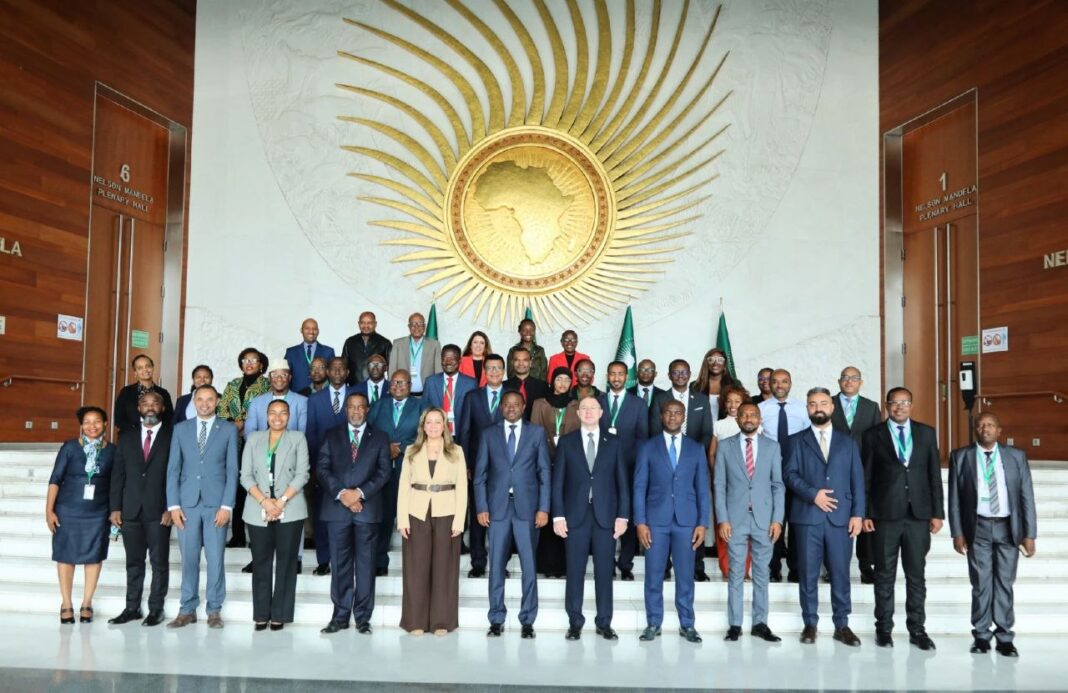

The Kenyan government is actively positioning the country as a primary regional processing and logistics hub for minerals and international trade. Speaking following a comprehensive briefing after the 28th Horn of Africa Initiative Ministerial Meeting, Trade and Industry Cabinet Secretary Lee Kinyanjui revealed that Kenya plans to pivot away from merely facilitating the movement of raw materials.
Instead, the strategic focus will shift toward attracting high-value investments in local mineral processing, modern logistics, and robust transport infrastructure aimed at creating sustainable jobs and enhancing the country’s overall global competitiveness.
Cabinet Secretary Kinyanjui emphasized that true wealth creation across the region relies heavily on establishing competitive transport costs, which can only be achieved through high-quality road networks and expanded rail systems.
The government’s vision includes attracting raw minerals from neighboring landlocked nations and processing them domestically within custom economic zones in coastal cities like Mombasa and Lamu.
To realize this ambition, Kenyan trade officials are already actively engaging international development partners, including Friederike Hemker, the Head of Development Cooperation for Sudan, and Trade Principal Secretary Regina Ombam, to establish collaborative frameworks for infrastructure funding and cross-border trade agreements.
This strategic shift highlights Kenya’s broader economic policy of leveraging its massive investments in transport infrastructure to capture a higher percentage of the value chain before commodities leave the continent. Kinyanjui argued that mega-infrastructure projects should no longer be viewed by policymakers as standalone engineering achievements, but rather as direct enablers of commercial trade.
According to the Trade Ministry, highways, deep-water ports, and railways only deliver meaningful economic returns to taxpayers when they successfully lower the cost of doing business, expand manufacturing exports, and support large-scale employment creation for the youth.
Central to this regional integration strategy is the Lamu Port-South Sudan-Ethiopia Transport (LAPSSET) Corridor. The multi-modal infrastructure project is expected to become an increasingly critical trade artery linking Kenya directly with Ethiopia, South Sudan, and Uganda.
Amid ongoing disruptions affecting traditional global shipping routes, such as the maritime volatility in the Red Sea, the government believes the case for the LAPSSET corridor has never been stronger. By positioning the Lamu Port as a secure transshipment hub, Kenya hopes to intercept cargo arriving from major Asian markets and efficiently redistribute those goods across East and Central Africa.
Beyond heavy physical infrastructure, the ministry is also aggressively targeting non-tariff barriers that historically choke intra-African commerce. The government is working in tandem with regional customs authorities to eliminate chronic delays at border checkpoints by digitizing customs declarations, reducing physical cargo clearance times, and improving the seamless cross-border movement of commercial trucks.
These efforts are part of a wider trade facilitation initiative aimed at creating a more predictable and investor-friendly environment across the Horn of Africa.
Despite these incremental steps forward, Kinyanjui highlighted a sobering reality: trade among African nations remains stubbornly low, accounting for only about 17 percent of the continent’s total commerce. This low figure underscores the urgent need to dismantle persistent structural bottlenecks and colonial-era trade routes that favor overseas export over regional exchange.
To unlock greater commercial activity, the ministry points to the tri-fold solution of improving regional transport networks, harmonizing border bureaucracy, and expanding access to digital trade. As internet connectivity and mobile money penetration continue to skyrocket across East Africa, digital e-commerce frameworks are expected to play a revolutionary role in bridging the trade gap.
Looking ahead, Kenya is preparing to advance these concrete proposals on regional logistics and mineral value addition at the upcoming Horn of Africa bilateral discussions in Addis Ababa, Ethiopia.
As global supply chains continue to realign due to geopolitical shifts, Kenya is determined to ensure it sits at the center of Africa’s emerging industrial architecture. By transforming from a passive transit corridor into an active value-adding powerhouse, the nation seeks to secure its economic future while lifting its neighbors into collective prosperity.