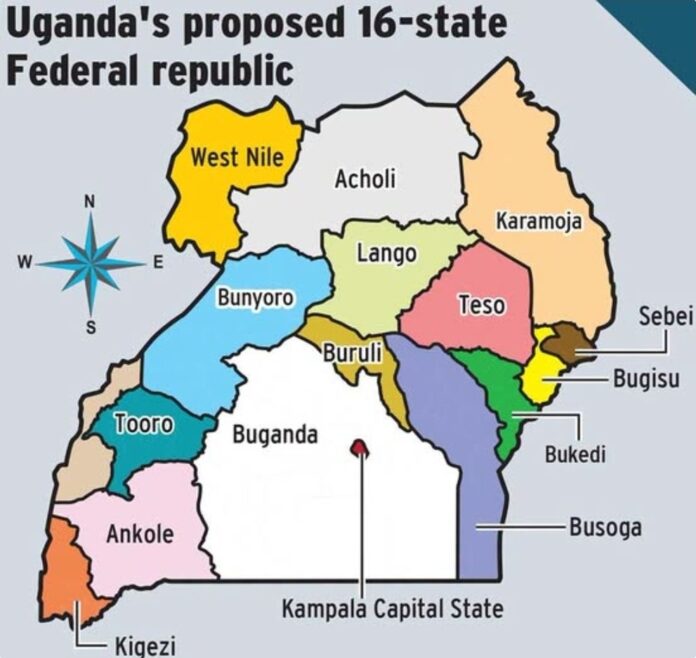
A sweeping new governance blueprint seeking to dismantle Uganda’s longstanding unitary state structure and transform the country into a federal republic has been unveiled, outlining an ambitious framework that would divide the nation into 16 semi-autonomous states, establish a two-chamber national Parliament, and constitutionally guarantee a 40 per cent share of national revenue for regional governments.
The document, widely referred to as Loyola’s Proposal and highlighted in a report by New Vision on Tuesday, presents a comprehensive alternative to Uganda’s current centralized administrative model. Under the proposed dispensation, the country would be reorganized into Kampala Capital State alongside 15 distinct regional states based largely on historical, cultural, and geographical groupings: Buganda, Buruli, Busoga, Bunyoro, Tooro, Ankole, Kigezi, West Nile, Acholi, Lango, Teso, Karamoja, Bugisu, Bukedi, and Sebei.
Proponents of the blueprint argue that decentralizing both political power and fiscal resources is essential for accelerating grassroots development and ensuring equitable representation across all regions. Under the proposed structure, each of the 16 states would operate its own regional government led by a directly elected governor, supported by state secretaries and a dedicated state legislative assembly. These regional administrations would wield substantial autonomy over local planning, public investment, and the direct delivery of essential public services, including healthcare, education, and local infrastructure.
A central pillar of the proposal is the restructuring of Uganda’s legislature. The blueprint calls for abolishing the current unicameral Parliament in favor of a bicameral national legislature comprising a lower house—the National Assembly—and an upper house, the Senate. While the National Assembly would continue to consist of members elected directly from constituencies alongside special interest group representatives, the newly created Senate would serve specifically as a chamber for regional interests. Each of the 16 federal states would be allocated one seat in the Senate, ensuring that smaller regions have an equal voice alongside larger ones in national decision-making and constitutional oversight.
To ensure that regional governments are financially viable and not overly dependent on central government handouts, Loyola’s Proposal introduces a strict constitutional revenue-sharing formula. Under this arrangement, 40 per cent of all national revenue would be remitted directly to the regional states, while the federal center would retain the remaining 60 per cent.
Based on current financial projections included in the blueprint, this 40 per cent allocation would channel approximately UGX 30 trillion directly to the regions—translating to roughly UGX 2 trillion annually per state to fund regional economic and social development priorities. Meanwhile, the federal government would manage the remaining UGX 42 to 43 trillion to finance core national mandates. These central responsibilities would include national defence, foreign policy and international relations, macroeconomic stability, monetary policy, and large-scale infrastructure projects that cut across multiple state boundaries.
While the blueprint has sparked renewed debate over federalism—locally known as federo, a long-standing political demand particularly in the Buganda region—its authors note that transitioning away from the current unitary system would require profound constitutional amendments and extensive legislative reforms.