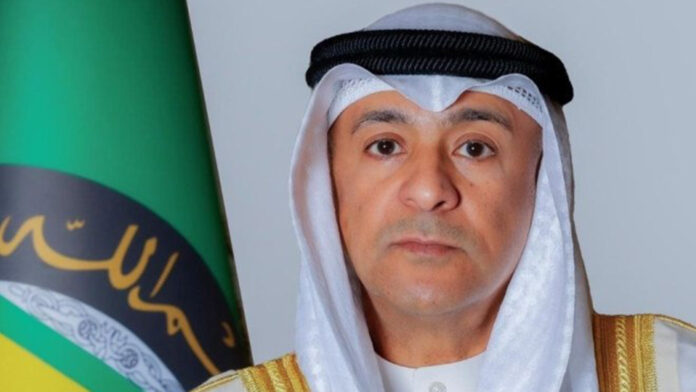
The Gulf Cooperation Council (GCC) has formally condemned statements made by officials of Somalia’s federal government accusing the United Arab Emirates (UAE) of interfering in Somalia’s domestic affairs. In an official communiqué issued on Thursday, November 19, 2026, GCC Secretary-General Jasem Mohamed Albudaiwi denounced Mogadishu’s rhetoric as “irresponsible” and rejected what he characterized as misleading and malicious media campaigns targeting one of the bloc’s member states.
Albudaiwi defended Abu Dhabi’s diplomatic standing, emphasizing that the UAE plays a vital and constructive role in consolidating regional security, stability, and international dialogue. To underscore this point, the Secretary-General highlighted the UAE’s recent hosting of peace negotiations between Russia and Ukraine as concrete evidence of its responsible approach to advancing global peace. He argued that Somalia’s accusations are unacceptable and serve only to undermine international cooperation. Reaffirming the solidarity of the six-nation bloc—which comprises Bahrain, Kuwait, Oman, Qatar, Saudi Arabia, and the UAE—Albudaiwi stated that Gulf states remain steadfast in supporting regional prosperity and will not be deterred by campaigns aimed at damaging the reputation of any member.
The GCC’s intervention injects a broader regional dimension into a rapidly escalating diplomatic rupture between Mogadishu and Abu Dhabi. Tensions boiled over earlier in the week following a televised address by Somali President Hassan Sheikh Mohamud. During his speech, Mohamud accused the UAE of undermining Somalia’s national sovereignty by providing unauthorized political, financial, and security support to regional administrations and armed groups operating outside the federal government’s control. He also sharply criticized Emirati commercial and security arrangements involving the strategic ports of Berbera, Bosaso, and Kismayo, maintaining that all foreign engagements must be negotiated directly through federal institutions in Mogadishu.
Following the President’s address, Somalia’s Cabinet took the drastic step of ordering the UAE ambassador to leave the country within 72 hours, while simultaneously recalling its own envoy from Abu Dhabi for consultations. Somali authorities defended the expulsions as a necessary measure to safeguard their territorial integrity and national unity.
In response, the UAE Foreign Ministry condemned Mogadishu’s actions as a “hostile approach” and accused Somali leadership of allowing internal political disputes to damage bilateral relations. Abu Dhabi also noted that it had already closed its embassy in Mogadishu and withdrawn its diplomatic personnel in January 2026 after Somalia unilaterally canceled existing bilateral port and security agreements.