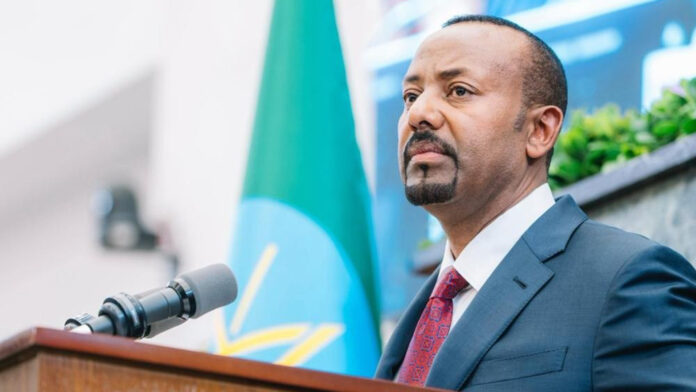
Ethiopia Prime Minister Abiy Ahmed has declared that Ethiopia will firmly continue to assert its national interests on its own terms, positioning the country as a decisive anchor state in the Horn of Africa. Speaking to the House of People’s Representatives after being sworn in for a new term under the newly established Medemer Government, the Prime Minister emphasized that Ethiopia’s growing economic power and national strength will anchor its regional leadership.
The Prime Minister’s address officially launched Ethiopia’s seventh parliamentary term, marking what he described as a pivotal transition from foundational institution-building to lasting national transformation.
Reflecting on the preceding years, PM Abiy characterized the period as a crucial crucible that tested Ethiopia’s resilience against severe domestic and external shocks. Despite global disruptions like the COVID-19 pandemic and coordinated geopolitical pressures, he noted that the nation persevered.
“When COVID-19 arrived and the world shut down, we continued with resolve. While campaigns were opened against us, as the world turned its back on us and repeatedly showed its injustice, we did not falter for a second,” Abiy stated.
He specifically pointed to the diplomatic and financial hurdles faced during the construction of the Grand Ethiopian Renaissance Dam (GERD). Describing efforts to stall the project, he remarked, “When they pulled us with a long rope to prevent us from bringing our dam to completion, we stumbled, but we did not fall, nor will we fall.” According to the Prime Minister, these trials have forged an invincible political-economy system capable of withstanding systemic obstacles.
A central pillar of the Prime Minister’s address was Ethiopia’s long-standing pursuit of reliable maritime access. In a region heavily reliant on trade corridors, Abiy stressed that securing a viable gateway to the sea is critical to Ethiopia’s long-term developmental vision.
Crucially, he reassured regional and international stakeholders that his administration will pursue maritime access through peaceful diplomacy, dialogue, mutual benefit, and a give-and-take framework, all while advancing domestic infrastructure projects.
To demonstrate that Ethiopia’s development goals are practical rather than rhetorical, the Prime Minister highlighted major victories in the agricultural and infrastructure sectors. He underscored the success of domestic wheat production initiatives, which have successfully transitioned the country from a major wheat importer to a self-sufficient producer capable of large-scale cultivation.
Furthermore, Abiy celebrated the full operationalization of major water and development projects, citing the final completion of the GERD, advancements on the Megech project, and the activation of the Tana Beles initiative.