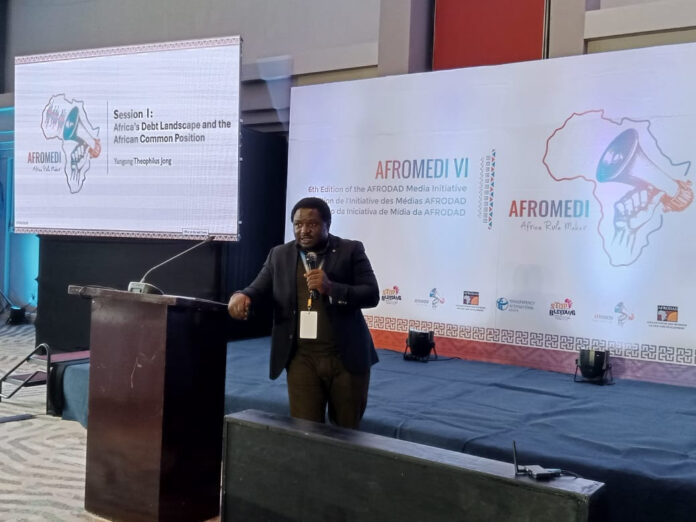
African journalists must act as bold voices to humanise complex debt issues and advance socio-economic justice while reshaping the continent’s common position on debt, AFRODAD Interim Executive Director Theophilus Youngong Jong and Transparency International Kenya’s Gibson Mwaita have urged, during the opening of AFROMEDI VI, writes Winston Mwale.
The three-day AFRODAD Media Initiative (AFROMEDI VI), running from 27 to 29 May 2026 under the theme “Partnering with Media to Advance Socio-Economic Justice and Africa’s Common Position on Debt,” has gathered 45 journalists from 29 African countries in Nairobi.
In their opening addresses, both speakers positioned journalists not as passive observers but as active drivers of change.
Jong stressed that debt is far more than figures — it directly affects classrooms, healthcare, and social welfare — while Mwaita highlighted how debt servicing crowds out spending on essential public services amid weak governance and corruption.
Together, they called for courageous, cross-border journalism that empowers citizens and challenges unfair global financial rules.
Jong welcomed participants and traced the programme’s roots to nearly three decades of AFRODAD’s advocacy, research, and policy work, which too often remained locked in elite spaces, leaving ordinary Africans disconnected.
“Journalists are not just messengers, but they are people who can take complex, sometimes very opaque issues, very technical issues, and humanize them, bring them down, and make them more accessible to the people,” Jong said.
He urged delegates to emerge as “room makers, not room takers” in the global financial architecture, connecting across borders to rewrite rules that have constrained Africa’s development since independence.
Since 2001, AFROMEDI has trained over 600 journalists from 37 countries through collaborative learning and network-building aimed at influencing policy at all levels.
Jong encouraged participants to approach the sessions with curiosity, produce impactful stories, and sustain networks that amplify citizen voices in debt conversations.
Gibson Mwaita, Head of Programs at Transparency International Kenya, delivered robust remarks on behalf of co-hosts, first injecting humour by clarifying he was not the listed speaker Shina Masinde and teaching visitors light-hearted Kenyan street phrases while assuring them of the country’s safety and urging them to explore its beauty.
Mwaita painted a stark continental picture: the majority of African countries now spend more on debt servicing than on education, health, infrastructure, and social protection, with many already in or near debt distress.
Citing the 2025 Corruption Perception Index, he noted sub-Saharan Africa’s average score of 32 out of 100, with only four of 29 countries above 50. Ten countries worsened while seven improved, revealing persistent governance gaps despite anti-corruption efforts.
“Africa is one of the richest continents in terms of resources… Even with such wealth, Africa still remains heavily in debt and has weak governance systems,” Mwaita said.
He described a new “scramble for Africa” by external actors and the painful irony that the continent consumes more of what it does not produce and produces less of what it consumes.
From TI Kenya’s work on citizen oversight and natural resource governance, Mwaita identified three critical pillars: beneficial ownership transparency to expose structures enabling corruption and illicit financial flows; timely access to information on contracts, expenditures, and revenues; and strong whistleblower protection to shield those who speak out from retaliation.
He told journalists they are “not merely observers but active participants and critical stakeholders” in reforms linking public debt, resource extraction, peace, stability, and governance.
“Do not stop doing the Lord’s work… continue asking the difficult questions,” Mwaita urged, noting media and civil society’s vital role in Kenya and across Africa.
The programme, partnered with Transparency International Kenya and the Start a Building Campaign — a Pan-African consortium on financial justice — will over three days delve into human stories behind debt statistics, resource-backed loans, Africa’s negotiating position, climate and environmental justice, and pathways to economic sovereignty.
Deepening the Debt Crisis: Context and Implications
Africa’s debt situation has reached alarming levels. According to various reports, public debt across the continent has surged post-COVID-19, with many nations allocating over 30% of revenues to servicing external obligations.
Countries like Zambia, Ethiopia, and Ghana have faced defaults or restructurings in recent years, underscoring systemic vulnerabilities.
Jong’s emphasis on humanising these numbers aligns with the need to show how debt burdens translate into reduced funding for SDG-aligned sectors.
For instance, education budgets in several nations have been cut to meet creditor payments, affecting millions of children.
Healthcare systems similarly strain under austerity, contributing to higher maternal mortality and disease outbreaks.
Mwaita’s corruption focus is particularly relevant. Weak governance exacerbates debt problems through inflated contracts, kickbacks in borrowing, and opaque resource deals.
Illicit financial flows from Africa are estimated at tens of billions annually, often linked to extractive industries.
Beneficial ownership registries, which Mwaita championed, could help track hidden owners of companies that secure lucrative mining or oil contracts while depriving states of fair revenue.
Access to information remains a battleground. Many African countries have right-to-information laws, but implementation lags, especially for loan agreements and debt contracts.
Journalists at AFROMEDI VI are expected to gain tools to navigate these barriers, demand disclosure, and hold leaders accountable.
Whistleblower protections, as highlighted by Mwaita, are equally urgent; reporters and activists exposing corruption frequently face threats, lawsuits, or violence.
Historical Perspective and AFRODAD’s Role
AFRODAD has been at the forefront of debt justice for nearly 30 years. Formed to advocate for fairer international financial systems, the organisation has consistently pushed for debt cancellation, responsible borrowing, and African-led solutions.
The AFROMEDI initiative represents a strategic shift — recognising that policy advocacy alone is insufficient without public awareness and pressure.
By training hundreds of journalists, AFRODAD aims to create a networked cadre capable of shaping narratives that influence elections, parliamentary debates, and international summits.
Jong’s call to be “room makers” echoes broader Pan-African aspirations seen in initiatives like the African Union’s Agenda 2063 and calls for reform of multilateral institutions such as the IMF and World Bank.
Unfair rules — from creditor preferences in restructuring to limited African voice in global forums — have perpetuated dependency.
Bold journalism can amplify demands for debt sustainability analyses that prioritise human development over repayment.
Partnerships and Practical Outcomes
The collaboration with Transparency International Kenya brings anti-corruption expertise, while the Start a Building Campaign adds civil society muscle on financial transparency.
Over the next days, sessions will feature expert panels, case studies, and storytelling workshops.
Journalists will examine resource-backed loans — often opaque Chinese or Western deals exchanging minerals for infrastructure — and explore climate debt, where African nations argue for reparations given their minimal emissions yet high vulnerability.
Mwaita’s encouragement to enjoy Kenya reflects the programme’s blend of serious work and networking.
Delegates are expected to visit sites, share experiences from diverse contexts — from conflict-affected areas to resource-rich economies — and build alliances that extend beyond the event.
Challenges and Opportunities for African Media
African media faces hurdles: shrinking civic space, economic pressures on outlets, digital misinformation, and safety risks.
Yet opportunities abound. Social media allows direct citizen engagement, data journalism can visualise debt impacts, and collaborative cross-border investigations can expose transnational issues like illicit flows.
Both speakers agreed that informed journalism strengthens democracy.
As Mwaita noted, media and CSOs have driven accountability in Kenya during turbulent political transitions.
Scaling this continent-wide could shift power dynamics, ensuring citizens — not just elites or creditors — shape debt policies.
Looking Ahead
As AFROMEDI VI unfolds, expectations are high. Jong and Mwaita’s combined message is clear: journalists must bridge the gap between technical boardroom discussions and everyday realities.
By humanising debt, exposing governance failures, and advocating justice, media can help Africa chart a path to sovereignty.
Participants are encouraged to leave not only with knowledge but with renewed commitment.
Networks formed here could spark joint reports, campaigns, and policy inputs. In a continent rich in potential yet burdened by debt, courageous storytelling remains a powerful tool for change.
The initiative arrives at a pivotal moment. With global debt discussions intensifying ahead of key summits, African voices — amplified through media — must be central.
Jong’s vision of accessible narratives and Mwaita’s focus on transparency and accountability provide a strong foundation.