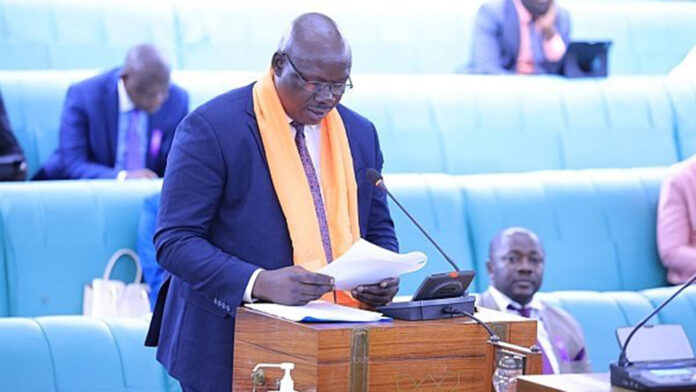
The Ugandan Parliament has cleared the way for a landmark legislative push to tackle severe food insecurity, granting Kilak North MP Anthony Akol leave to introduce a private member’s bill aimed at establishing mandatory food reserves. The proposed Food and Nutrition Bill, 2026 comes at a critical juncture as recent assessments indicate that approximately 3.6 million people in evaluated areas are grappling with crisis-level acute food insecurity or worse.
If enacted, the bill would institute a comprehensive legal framework requiring the establishment of food reserves at national, district, and household levels. Furthermore, it would enshrine a legal right to food for Ugandan citizens—a fundamental protection currently absent from existing national laws.
Presenting the motion to the House, MP Anthony Akol argued that existing regulatory frameworks fall significantly short of protecting vulnerable populations. He pointed out that the government’s own recently introduced Food and Agriculture Regulatory Authority Bill, 2026 focuses heavily on licensing and inspecting food, feed, veterinary medicines, and farm chemicals, yet completely bypasses the legal right to food and structural nutrition security.
“Recent assessments demonstrate substantial food insecurity, with the 2026 Integrated Food Security Phase Classification analysis estimating that approximately 3.6 million people in the areas assessed were experiencing crisis-level or worse acute food insecurity,” Akol told lawmakers.
Echoing these concerns, Pian County MP Remigio Achia blamed recurring droughts for exacerbating regional disparities. He noted that severe hunger persists in parts of the country despite adequate food production elsewhere, attributing the imbalance directly to a lack of centralized government storage, monitoring, and distribution mechanisms. The north-eastern region of Karamoja remains particularly hard-hit, prompting urgent calls from parliamentarians for immediate safety nets, such as free school feeding programs in the area. Across the broader East and Southern African region, acute hunger is projected to impact up to 16.4 million people as El Niño weather patterns drive prolonged droughts.
While Parliament overwhelmingly supported the principle of addressing hunger, the executive branch signaled that the proposal will likely undergo legislative synchronization. Desire Muhooza, the State Minister for Agriculture, announced that the government is actively preparing its own comprehensive Crop Bill, which is expected to cover many of the objectives outlined in Akol’s private member’s bill.
“We are going to invite him so that we harmonise with most of what we are working on, and very soon, we shall bring the Crop Bill to the floor of the House,” Muhooza stated.
Seconding the initial motion, Adjumani District Woman MP Jesca Ababiku emphasized that unchecked food insecurity inflicts severe damage on both public health and economic productivity, noting that structured food reserves would also provide much-needed market stability for local farmers. Additional lawmakers, including Western Youth MP Mwine Tumwebaze, expanded the scope of the debate to advocate for institutional feeding programs across higher education levels.
Under standard Ugandan legislative procedure, the bill’s sponsor must now present the draft alongside a formal certificate of financial implications before its official first reading. Following that, a parliamentary committee will examine the text in detail. While private members’ bills frequently merge with or pave the way for parallel government-sponsored legislation, Thursday’s initial approval marks a vital step toward legally binding food security accountability in Uganda.