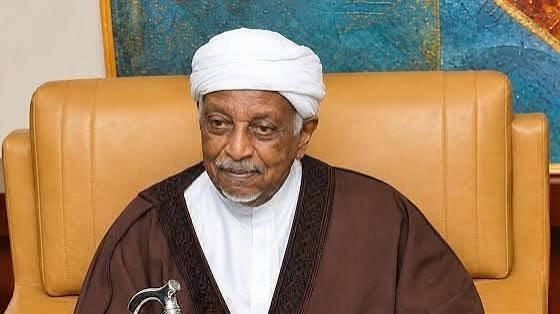
The family of the late Sudanese religious and political leader Mohamed Osman al-Mirghani has named his eldest son, Ali, as the new spiritual guide of the Khatmiyya Sufi order, one of Sudan’s largest and most influential religious sects. The announcement, made in a family statement read by his brother Jaafar al-Sadiq, settles the question of succession at the helm of the order but leaves the leadership of the family’s political wing, the Democratic Unionist Party (DUP), undecided — setting the stage for an expected fierce rivalry between two of the late leader’s other sons.
Reading the family’s statement, Jaafar al-Sadiq said the family had united behind his eldest brother to succeed their father as guide of the Khatmiyya order. “My brothers and I are the first to stand behind him, support him, and place our hands in his to serve the order and its people,” Jaafar said, in a show of family solidarity intended to project continuity and calm among followers.
In his first address as spiritual leader, Ali al-Mirghani urged followers to manage differences through dialogue, listen to opposing views, reject division, and support efforts toward reconciliation and unity. The message appeared aimed at steering the order through a delicate period in which religious authority has been settled but political authority within the DUP remains contested.
Ali al-Mirghani has resided in the United States since the mid-1990s, a factor that some observers say could shape both his style of leadership and his engagement with the order’s affairs in Sudan. His father, Mohamed Osman al-Mirghani, died last Friday in Cairo and was buried on Monday at the Sayyid Ali al-Mirghani Mosque in Khartoum North, following funeral ceremonies that drew prominent religious and political figures.
While the spiritual succession has been resolved smoothly, attention now turns to the DUP presidency, where a fierce rivalry is expected between Mohamed al-Hassan and Jaafar al-Sadiq, two of the late leader’s other sons. Tensions over the party leadership began during Mohamed Osman al-Mirghani’s lifetime, when the two brothers clashed over the party’s number-two post of deputy chairman for organizational affairs. The rift has been fuelled by their opposing stances on Sudan’s ongoing conflict, with al-Hassan aligned with anti-war civilian forces and Jaafar backing the Sudanese army in its war against the paramilitary Rapid Support Forces.
The Khatmiyya order has long been a pillar of Sudanese religious and political life, and its leadership carries significant weight among followers across the country. The late Mohamed Osman al-Mirghani was both a spiritual guide and a political figure, and his death has raised questions about how the intertwined religious and political roles he held will be distributed among his successors.
Analysts say the family’s swift endorsement of Ali as spiritual guide may help preserve the order’s cohesion at a time when Sudan’s political landscape remains fractured by war. However, the unresolved DUP presidency could deepen existing divisions, particularly given the brothers’ divergent positions on the conflict — a fault line that mirrors broader splits within Sudanese civilian and political forces.
For now, the family has presented a unified front, with Jaafar’s public pledge of allegiance to his elder brother signaling a desire to avoid a schism within the order itself. Whether that unity can extend to the party’s leadership contest remains an open question, one that is likely to shape the future of both the Khatmiyya order and the DUP in the months ahead.