
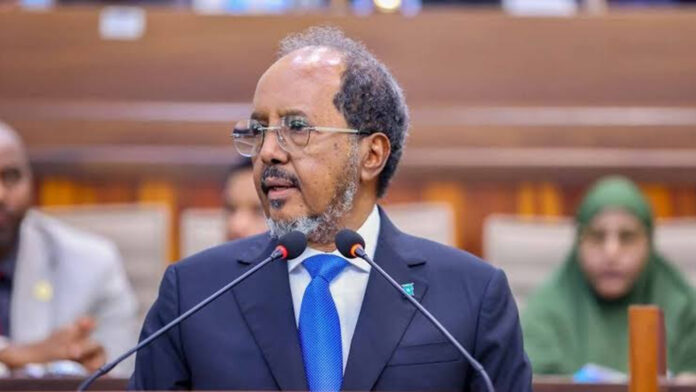
Somali President Hassan Sheikh Mohamud delivered a televised address to the nation on Tuesday night, accusing the United Arab Emirates of “blatant” interference in Somalia’s internal affairs and revealing that Abu Dhabi has established military bases and forces outside the federal government’s national security framework. The speech marks the most direct and severe public accusation by Mogadishu against the Gulf state in recent years, pushing the already fragile bilateral relationship to a new low.
Mohamud stated that the UAE has long pursued policies aimed at weakening the authority of Somalia’s central government, deepening political divisions, and building security structures outside the national system. He specifically pointed out that the UAE helped establish military bases and armed forces that are not fully under Somali national security command, and that these “parallel structures” weaken the cohesion of Somali forces at a critical time when the country is fighting terrorist groups such as al-Shabaab. “I did not come before you to discuss trivial matters,” Mohamud said in his address, describing the UAE’s actions as a violation of Somalia’s sovereignty.
Regarding port agreements, Mohamud accused the UAE of signing deals involving the ports of Berbera, Bosaso, and Kismayo with regional administrations within Somalia, bypassing federal government authority. He emphasized that Somalia’s ports are national assets, and any agreement involving national sovereignty, security, and strategic interests must be based on the constitution and the authority of the federal government. Berbera is located in the Somaliland region, which unilaterally declared “independence,” while Bosaso is in the semi-autonomous Puntland state, and Kismayo is in Jubaland state. The UAE has significant commercial and security interests in these areas.
The Somali president also revealed that the UAE played a role in Israel’s recognition of Somalia’s northern regions and refused to sign statements from Arab and Islamic countries condemning the move. He further mentioned that in January 2026, the UAE used Somali territory in Berbera as a transit route to transfer a militia leader fleeing from Yemen without the consent of the federal government. According to reports, the leader in question was Aidarous al-Zubaidi, head of the UAE-backed Southern Transitional Council in Yemen, who fled by boat from Aden to Berbera and then transited through Mogadishu to Abu Dhabi.
This public accusation is the latest development in an escalating diplomatic crisis between Somalia and the UAE. On January 12, 2026, Somalia’s cabinet announced the annulment of all agreements with the UAE, including security, defense, and economic cooperation, as well as port agreements involving Berbera, Bosaso, and Kismayo. The cabinet statement said the decision was based on “credible reports and strong evidence” indicating that the UAE had taken actions undermining Somalia’s sovereignty, national unity, and political independence. Subsequently, Somalia closed its airspace to UAE military and cargo aircraft.
However, the roots of the Somalia-UAE rift go back further. In April 2018, Somali security forces seized $9.6 million in cash from a UAE aircraft at Mogadishu airport, and the UAE subsequently announced the termination of its military training mission in Somalia. The UAE claimed the funds were intended to pay and train Somali soldiers, and condemned Somalia’s actions as “illegal” and a violation of diplomatic norms. The two countries have also clashed over the UAE-owned DP World’s port investment in Berbera, with Somalia regarding the agreement as “null and void”.
Despite the sharp accusations, Mohamud left room for reconciliation. He reiterated that his government is willing to establish relations with the UAE based on equality and mutual respect, and emphasized that Somalia’s grievance is directed at the UAE government’s policies, not at the Emirati people, nor at Somali nationals living in the UAE. He called on Somalis to strengthen internal unity, warning that the greatest threat to Somalia is not only foreign interference but also internal division, which provides opportunities for external forces.
Analysts note that this diplomatic confrontation occurs against the backdrop of intensifying geopolitical competition in the Horn of Africa, where Turkey, Egypt, Saudi Arabia, and the UAE are all seeking to expand their influence. The UAE has not yet formally responded to Mohamud’s latest accusations. The Somali government’s next challenge will be how to manage the impact of this dispute on its ongoing security operations against al-Shabaab and its relations with regional federal states.