Kenya is on the brink of exiting the Financial Action Task Force’s (FATF) “grey list” of jurisdictions under increased monitoring, having successfully addressed more than 90 per cent of the required structural reforms.
Internal Security and National Administration Principal Secretary Raymond Omollo announced that as of October 2026, the country has substantially resolved 19 out of the 21 action items outlined in its national International Cooperation Review Group (ICRG) Action Plan. The milestone demonstrates Kenya’s firm political commitment to rectifying historical vulnerabilities in its systems for combating money laundering, terrorist financing, and the proliferation of weapons of mass destruction.
Speaking in Nairobi during the Global CFT Expert Hub Conference 2026—a premier three-day international forum convening over 150 delegates from governments, civil society, and multilateral institutions—PS Omollo emphasized that the sweeping reforms are designed to align the nation’s financial integrity frameworks with stringent international standards.
Kenya was initially placed on the FATF grey list after making a high-level political commitment in February 2024 to work alongside the global standard-setting body and the Eastern and Southern Africa Anti-Money Laundering Group (ESAAMLG). Since then, the government has accelerated a comprehensive overhaul of its regulatory environment.
Key among these measures is the strengthening of risk-based supervision across financial institutions and designated non-financial businesses and professions (DNFBPs). Authorities have notably improved compliance with preventive protocols, including the filing of suspicious transaction reports (STRs). Additionally, the government has designated a formal authority to regulate trusts, bolstered the collection of accurate beneficial ownership data, and sharpened the quality and operational use of financial intelligence products.
Kenya has also successfully aligned its targeted financial sanctions framework with FATF Recommendation 6, ensuring that measures to freeze terrorist assets are swift, comprehensive, and legally sound.
A cornerstone of Kenya’s reform strategy has been reforming the oversight of non-profit organisations (NPOs) to prevent abuse by bad actors without stifling vital humanitarian and civic work. PS Omollo highlighted that an effective counter-terrorist financing regime must be both firm against exploitation and proportionate in its application.
To anchor this policy in reality rather than assumption, the government undertook a rigorous risk assessment of 260 faith-based and charitable organisations across nine high-risk counties. The findings revealed that 76.2 per cent of these entities fell into the Medium-Low Risk category, with only 1.2 per cent classified as High Risk.
Reflecting these evidence-based findings, the state designated the Public Benefit Organizations Regulatory Authority (PBORA) as the dedicated sector supervisor, operationalized the Public Benefit Organizations Act along with the 2026 PBO Regulations, and lifted mandatory reporting burdens that previously blanketed the entire sector.
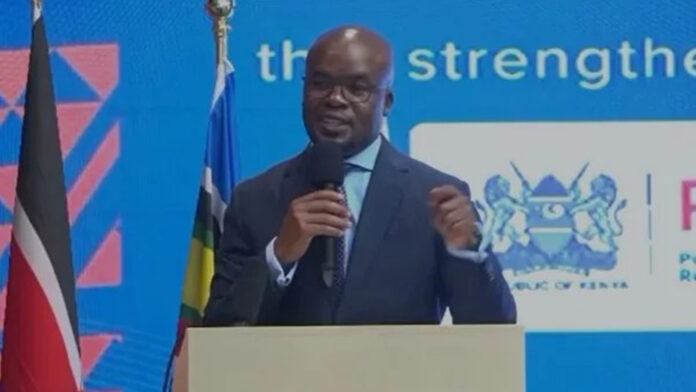
PBORA Director General Laxmana Kiptoo reinforced this commitment during the conference, noting that the new regulatory approach aims to foster transparency and accountability while safeguarding the operational space of legitimate organisations.
Beyond regulatory compliance, Kenyan authorities are actively tackling the growing challenge of “de-risking”—a phenomenon where risk-averse commercial financial institutions arbitrarily sever banking access for entire sectors, such as charities and non-profits, due to perceived vulnerabilities. Omollo urged financial institutions to adopt intelligent, evidence-based risk management rather than blanket risk avoidance.
International stakeholders at the conference commended Nairobi’s swift progress. Christopher Likomwa, representing the Executive Secretary of ESAAMLG, noted that regional collaboration remains paramount as countries undergo their third round of mutual evaluations. Meanwhile, Kodjo Attisso, Coordinator of the UNODC-ROEA Illicit Finance Fusion Center, praised Kenya’s shift toward measuring the true operational effectiveness of its anti-money laundering frameworks rather than relying purely on technical compliance.