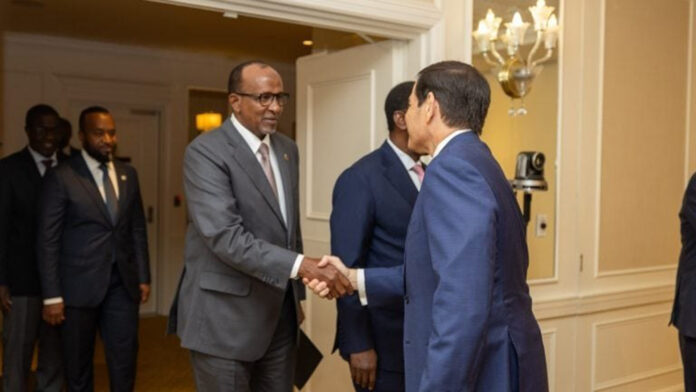
Health Cabinet Secretary Aden Duale has announced substantial progress in Kenya’s healthcare partnership with the United States following high-level discussions in New York. The talks, held on the sidelines of the 81st Session of the United Nations General Assembly (UNGA 81), brought together Kenyan President William Ruto and U.S. Secretary of State Marco Rubio to evaluate the rollout of the bilateral Government-to-Government (G-to-G) Health Cooperation Framework.
In a statement shared via his official X (formerly Twitter) account, CS Duale emphasized that the engagement successfully reaffirmed the strong diplomatic and developmental ties binding Nairobi and Washington. The primary objective of the review meeting was to measure milestones achieved in fortifying national health systems, boosting medical research capabilities, and accelerating workforce capacity building.
Duale noted that these core pillars are fundamental to Kenya’s national ambition of attaining Universal Health Coverage (UHC). By aligning international support with domestic reforms, the partnership aims to optimize healthcare service delivery, elevate clinical training standards, and optimize health outcomes for millions of citizens nationwide.
The ongoing discussions anchor directly on the landmark five-year health cooperation agreement finalized in Washington, D.C.. Formulated as part of broader shifts in international development assistance, this pact represents the first bilateral health arrangement of its kind between the United States and an African nation.
Under the terms of the accord, the United States committed upward of $1.6 billion (approximately Ksh208 billion) across a five-year lifecycle to support critical segments of Kenya’s health infrastructure. Concurrently, the Kenyan government has pledged matching domestic investments to secure long-term financial sustainability and national ownership. Funding is channeled toward targeted interventions addressing infectious and chronic burdens, including HIV/AIDS, tuberculosis, malaria, maternal and child healthcare, robust disease surveillance, and systemic health administration.
A central theme during the UNGA review was the strategic emphasis placed on medical research and professional skills development. Expanding institutional capacity building is expected to equip Kenya’s medical workforce to better handle emerging epidemiological shocks and complex public health challenges. Furthermore, the framework channels resources into upgrading laboratory systems, modernizing healthcare infrastructure, and fostering homegrown digital health innovations.
Despite the positive momentum underscored during the diplomatic review, the bilateral framework has encountered notable public discourse and civil society debate since its inception. Earlier in the year, specific clauses—such as proposals surrounding specialized containment or quarantine facilities for foreign personnel—drew intense scrutiny from health practitioners and legal advocates, triggering public discussions regarding national protocols and sovereignty.