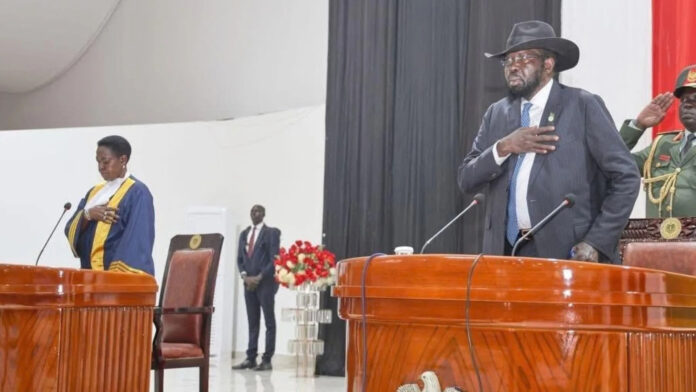
South Sudan has reached a critical political crossroads as President Salva Kiir officially dissolved the country’s transitional unity government, marking a definitive end to the power-sharing framework established under the 2018 peace agreement. The sweeping decree, announced during an expanded meeting in Juba, transitions the nation into a caretaker administration as it sprints toward its first-ever general elections since gaining independence in 2011, scheduled for December 22, 2026.
The dissolution follows the recent passage and presidential assent of vital amendments to the National Elections Act. These legal adjustments successfully removed long-standing institutional roadblocks—specifically, the mandates requiring a finalized permanent constitution and a national population census prior to holding a vote. By clearing these hurdles, the government has established a firm electoral timeline, though the maneuvers have triggered intense domestic debate. Critics and opposition groups have labeled the unilateral structural changes a setback for consensus-building, raising deep concerns that the dismantling of the power-sharing arrangement leaves President Kiir with unchecked executive authority during the transition.
Under the new caretaker setup, the national legislature and state governments have been dissolved, and the positions of the country’s vice presidents—including the suspended First Vice President Riek Machar, who remains under legal scrutiny—have been vacated. President Kiir will retain full constitutional command to steer the country through the interim period, while selected ministers have been reassigned to caretaker portfolios to ensure basic administrative continuity across key dockets like finance, defense, security, and foreign affairs.
Ahead of the announcement, security was visibly tightened across Juba, with military and security forces deployed around strategic government zones and ministry buildings to monitor stability. International bodies, including the European Union and the Reconstituted Joint Monitoring and Evaluation Commission (RJMEC), have urged utmost caution, warning that the incoming caretaker administration must strictly limit its scope to managing the electoral process while preserving whatever remains of the fragile peace architecture.
As South Sudan navigates these turbulent final three months before polling day, attention will focus sharply on the National Elections Commission’s ability to execute a credible vote. With deep political divisions remaining unaddressed, the success of the December 22 election will test whether the nation can securely transition from a prolonged era of conflict into a stable, democratic future.